SAN FRANCISCO TO ST. PETERSBURG BY RAIL!
A 1906 newspaper feature on Baron Léon Loicq de Lobel’s transcontinental railway proposal linking Siberia and Alaska through the Bering Strait.
By Frederic W. Bishop
The San Francisco Sunday Call, Volume 100, Number 94, September 2, 1906
🔍 Click any image to enlarge and view details.
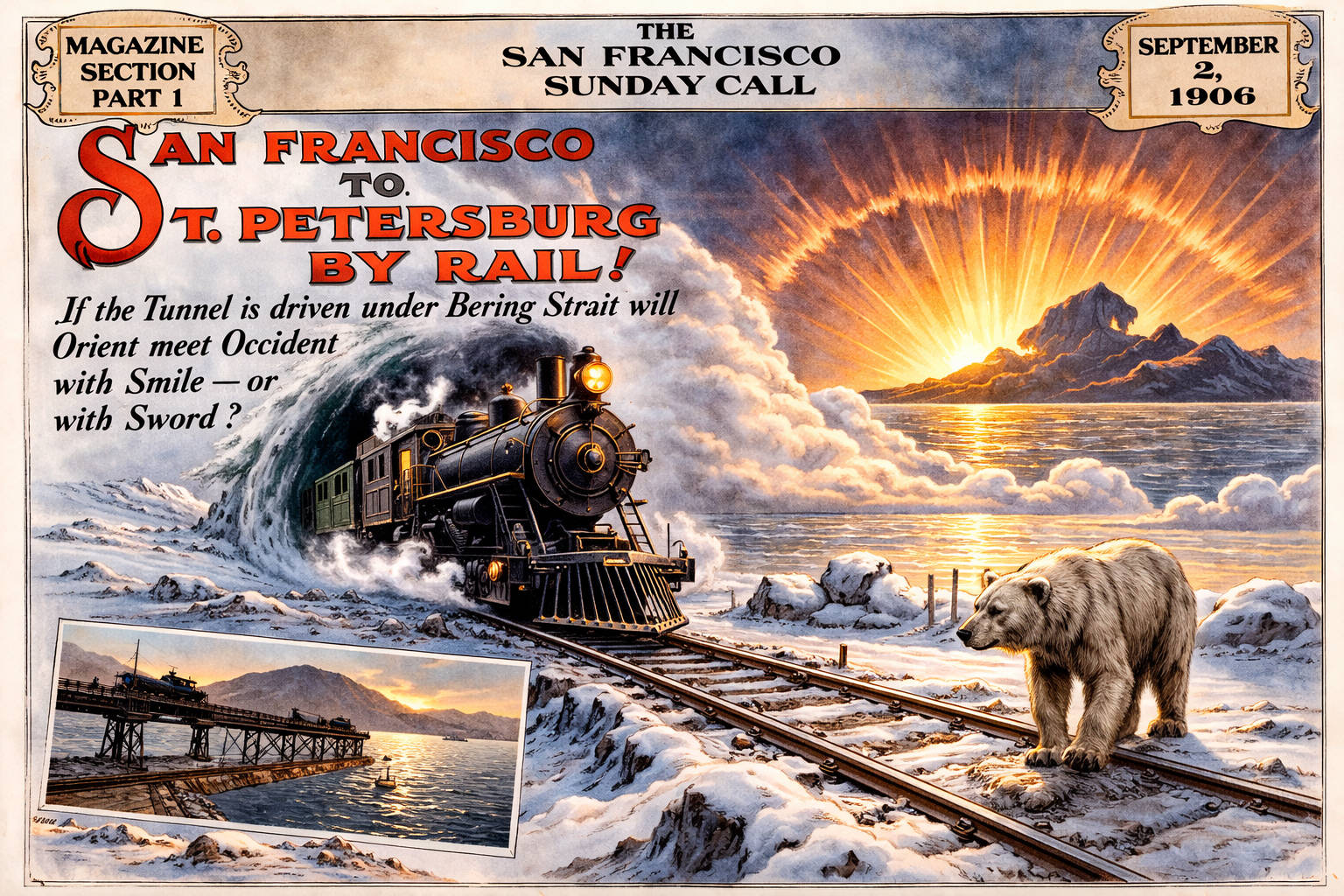 San Francisco to Saint Petersburg by Rail!
Source: The San Francisco Sunday Call, Volume 100, Number 94, September 2, 1906
PARIS— In accordance with an order issued by the Emperor of Russia the American syndicate, represented by
Baron Loicq de Lobel,
is authorized to begin work on the Trans-Siberian-Alaska railroad project. The plan is to build a railroad from Siberia to Alaska by tunneling under Bering Strait. It is said the enterprise will be capitalized at $300,000,000, and that the money centers of Russia, France and the United States will be asked to take bonds.
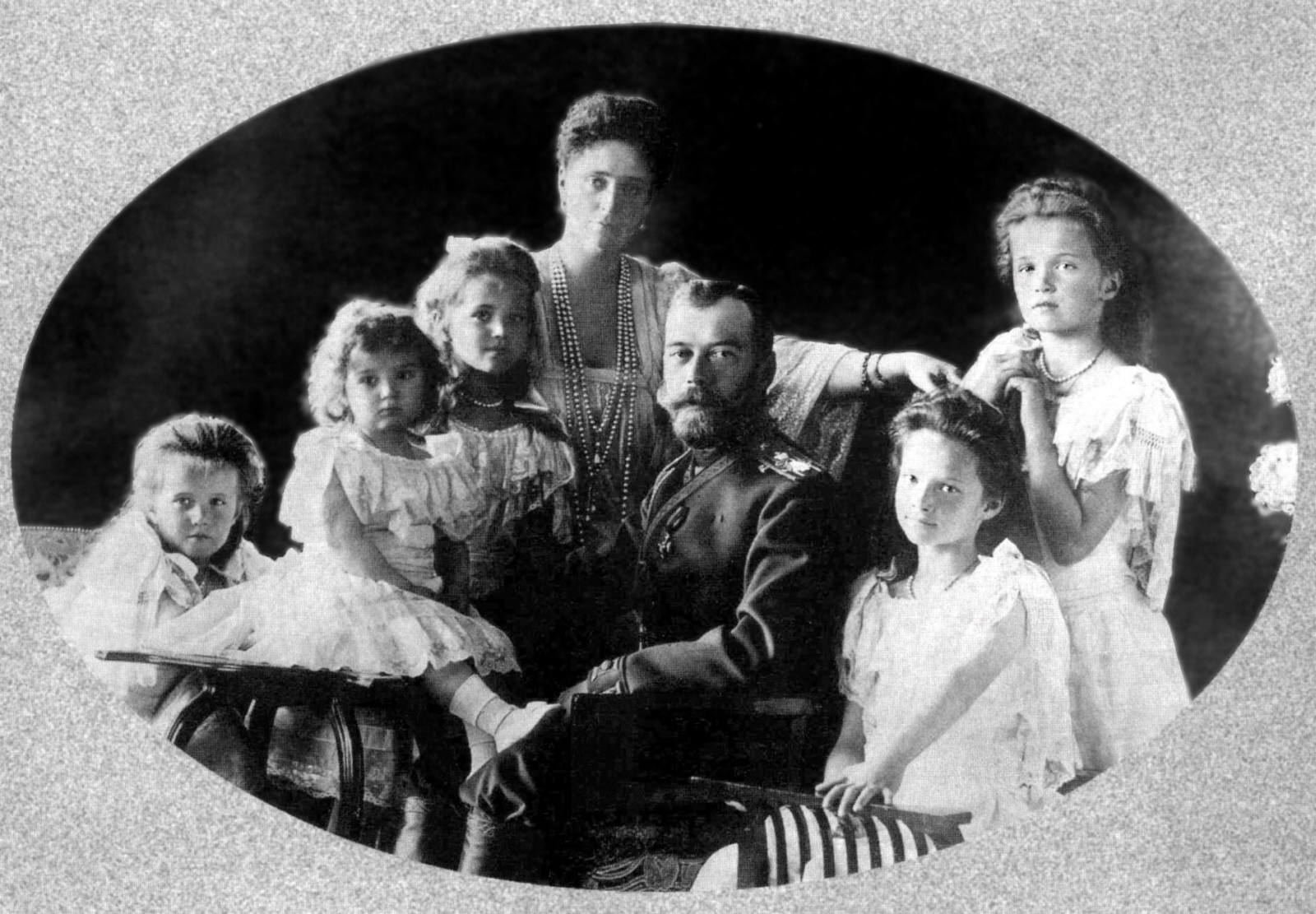 Russian Emperor of Russia, Nikolas II, with his family, in 1906.
Source: Wikipedia
FAR back in the centuries, when the first swart-skinned Mongolian stood on the bleak Siberian shore, then an unnamed wilderness, and looked across where ice-clad crags girt the Western land, he little dreamed that before the end of time man, with tremendous courage, should plan to pierce the earth there beneath his feet and weld two continents with bands of steel; he little dreamed that man should plan to send great vehicles, the very appearance of which would have sent him to his knees, praying to the God he knew for deliverance, speeding beneath the frozen sea on their journey from Occident to Orient; he little dreamed that the land upon which his were the first human eyes to rest should, in the flight of ages, become the stronghold of the leader of the nations; he little dreamed that through the desolation behind him armies would scar the earth in their clamor for its possession.
But these things have come to pass; America stands imperial among the lands of the earth and Siberia, where peace rests at last, grows apace. True, between these lands there is the eternal highway of the ocean, but in the speed-madness of the time men look for quicker and safer means of transportation than the greyhounds of the ocean can offer, and they look for giant problems to try their strength.
 Bering Strait, where the Natives cross it in canoes.
Source: The San Francisco Sunday Call, Volume 100, Number 94, September 2, 1906
When out of chaos the world took shape and continents arose and shook the waters from their chests, with titanic throes that split the rocks and builded the mountains, there remained between the Eastern and the Western Hemispheres an everflowing stream, thirty-six miles wide, which man has christened Bering Strait. In the center of the strait are the Diomede Islands, the greater and the lesser, the former the property of Russia, the latter boasting the protection of the stars and stripes. To a daring Frenchman, Baron Loicq de Lobel, now must go the honor that is due even the conception of the colossal scheme to tunnel from the American side far beneath the strait, come up through the greater Diomede, to breathe as it were, and go down again to break at last through the crust of Asia and stand on her soil, master of one of the greatest engineering problems ever undertaken by man.
But if honor is due Baron Loicq de Lobel, likewise it is due the United States Government, which first turned the attention of the world to the fact that at Bering Strait the Old World brushes closest to the New. Before the laying of the first Atlantic cable the Government sought to execute a plan to link the telegraphs of Europe with those of America by spanning these thirty-six miles of storm-tossed waters. It was the plan to lay a cable from Cape Prince of Wales on the American side to Plover Bay, Siberia, but the ever-moving icebergs plowed their way onward with resistless force, with the result that a wire, alive with messages today, would be broken tomorrow and lie dead beneath the waves. But all the while the engineers were struggling to overcome what seemed an impossible task; were surveying the peninsula and running their land lines to the remotest corners of Alaska; they only ceased their labors when word was carried to them that the Atlantic had been conquered and at last America and England were united by copper strands. So the first effort to best the forces of Bering Strait was abandoned, but this was the birth of the dream to join the East and the West by rail-a dream that Baron Loicq de Lobel is now striving to make a reality.
 Baron Léon Loicq de Lobel (September 9, 1859, Bastogne, Belgium - May 8, 1922, Paris, France).
One of the earliest 20th-century proponents of a Bering Strait fixed link connecting Siberia and Alaska.
Source: InterBering Historical Archive
In the discussion of this gigantic plan there are four questions that take precedence — the engineering, the commercial, the financial and the strategic — the last commanding attention through the fact that the world has not yet consented to disarm and the fact that within the hearts of the yellow men of Asia there is a hatred for the West. Troopships at best are limited in capacity and frail against assault. Will the joining of America to Asia by a tube of steel destroy the safety each now enjoys by reason of its isolation?
Of the four questions the mind is first thrilled by the contemplation of the engineering problems. Were it announced that a tube was to pierce the Rocky Mountains at their base, to run through the earth eighteen, thirty-six, a hundred miles, engineers would be all attention, but the laymen, accustomed to miracles of science, would say that it was well and forget about it, to remain indifferent, unless, perhaps, in the course of time it aided them in their haste to reach a destination. Then they would be thankful for its existence, to forget it again when its service was no longer needed. It is the mystery, the silence, the white desolation of the Arctic regions that lends the flash of romance to this scheme of the French nobleman to join Occident to Orient, and it is the mystery, the silence and the dread of the deep, beneath which this tube of steel must pass, that lends to it its terror and its awe.
Roughly speaking, the channel between the Alaskan shore and the greater Diomede Island is eighteen miles in width and 180 feet at its greatest depth. It is the plan to start the tunnel from the American side, well back from the shore, and drive an incline out beneath the sea. Until the depth of 100 feet is reached, the tunnel will be driven with the assistance of a caisson, behind which naked men, gasping in the tremendous pressure of air forced within to keep back the percolating waters from above, will dig and blast their way toward the Asian goal.
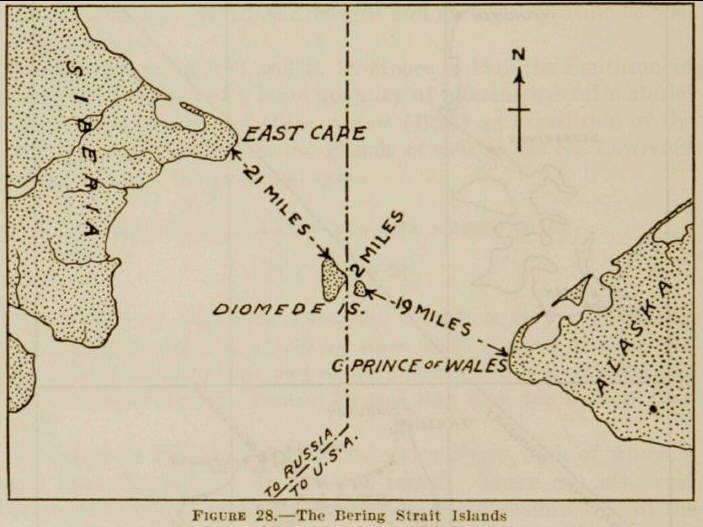 Two small islands are situated midway between the continental land masses. Big Diomede Island belongs to Russia; Little Diomede Island belongs to the United States. The islands are separated by approximately two miles—and the International Date Line.
Source: The Russia Connection: Historical Proposals to Reestablish a Land Link across the Bering Strait
When 100 feet is reached, should the salt sea still force its way through pore and crevice, pumps must be utilized, for the giant does not live who can stand air pressure sufficient to hold out the waters at a greater depth. But Baron Loicq de Lobel and those associated with him, under whose supervision soundings have been made, are confident that at 100 feet a formation so uniform and hard will be found that the tunnel roof will stand with little support and the waters will cease to flow. Should their theory be verified, nothing will then remain but to fight their way forward beneath the sea, with powder and pick, a problem any miner would undertake with full confidence of success.
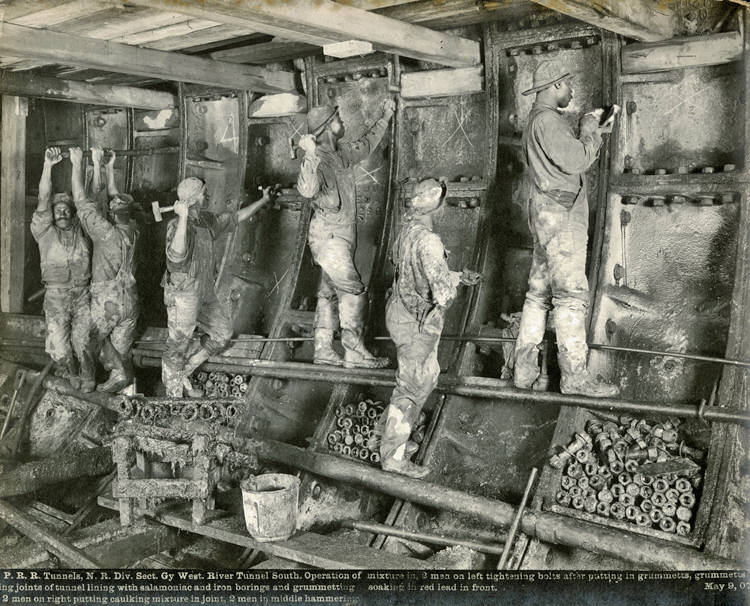 African American sandhog crew tightening bolts in the west section of the Hudson River tunnel beneath the river, May 9, 1907.
At the time this article was published in 1906, construction of the Hudson River tunnel between New Jersey and New York represented the most advanced subaqueous tunneling work in the United States and served as a practical engineering precedent for future projects such as a proposed Bering Strait tunnel.
Source: Battling Under the River
When, the plans say, the surveyors announce that the tunnel end is beneath the center of the greater Diomede, an upraise will be cut to the surface, and a midway station will be established. When the shore of Asia is neared, should fortune favor the workers, the caisson will again be utilized until its iron nose emerges through the soil of Siberia and then, while wild-eyed Eskimos stare in bewilderment, cheers for the Old World and the New will ring through the solitude. Throughout its length the engineers propose to support the tunnel with great rings of steel, protected from the moisture by cement and asphalt, and when this is done the ravages of time shall not prevail against them.
While not an enthusiast as to the De Lobel scheme, no less an authority than William Hood, chief engineer of the Southern Pacific Company, says the driving of a tunnel beneath the Bering Strait would be impossible only in case the stratum of the bed was so shattered by the convulsions of the earth as to pour water in resistless streams down on the heads of those who sought to pierce it. If this stratum is sound, as De Lobel asserts it is, Hood says all remaining problems can be solved. However, he ventures the opinion, there is no stretch of eighteen miles on the earth that would not contain fractures of greater or less seriousness. This, then, is the greatest hazard that confronts those who propose driving the tunnel. If luck is theirs the earth will be solid; if not the Bering tunnel may go no farther than the first fissure beneath the level of 100 feet, below which no human power can successfully cope with the pressure of the sea.
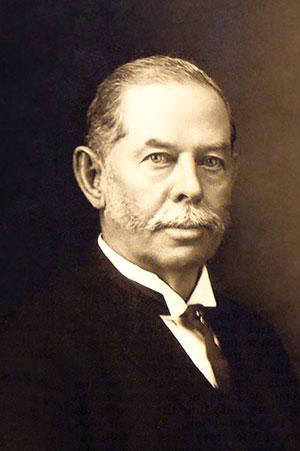 William Hood (February 4, 1846, Concord, Merrimack County, New Hampshire - August 26, 1926, San Francisco, California).
Chief Engineer of the Southern Pacific Railway System, 1900-1921.
Source: Find a Grave
To join the line, should the tunnel be completed, with the trans-Siberian railway at Irkutsk would be the work of but a few years, as the engineering problems on the Asiatic side are simple. On the Alaskan end it is different. Some engineers assert that the work of constructing the tunnel beneath Bering Strait would be easy in comparison with the problems to be met in crossing the mountains and glaciers of Northwestern Alaska.
It is quite probable that Port Simpson, on the southeastern edge of Alaska, and the northern terminal of the Grand Trunk Pacific, will be selected as the southern terminal of the proposed trans-Alaskan-Siberian railway. As the Arctic pigeons fly, Port Simpson is 1500 miles from Cape Prince of Wales, the American end of the Bering tunnel, and it is asserted that any practicable route over which a locomotive could labor on its up and down hill way would be 1000 miles farther, but these things the surveyor must determine. All of the way is over the precipitous Canadian Rockies and the Alaska Mountains, but these problems only serve to enthuse rather than to depress the promoter and his associates, who number among them some of the foremost men of France.
But if James J. Hill, the indomitable president of the Great Northern, has been correctly quoted, he may save Baron Loicq de Lobel the work of solving the problem on the American side. Northern papers say that Hill has turned his mind to the development of the great mineral and agricultural resources of Alaska and now has men in the field surveying a route for a spur of his system through to the Klondike and thence, following the windings of the Yukon, to Nome. Should this project be carried through it would leave De Lobel and his associates but a few hundred miles of mountains to grapple with.
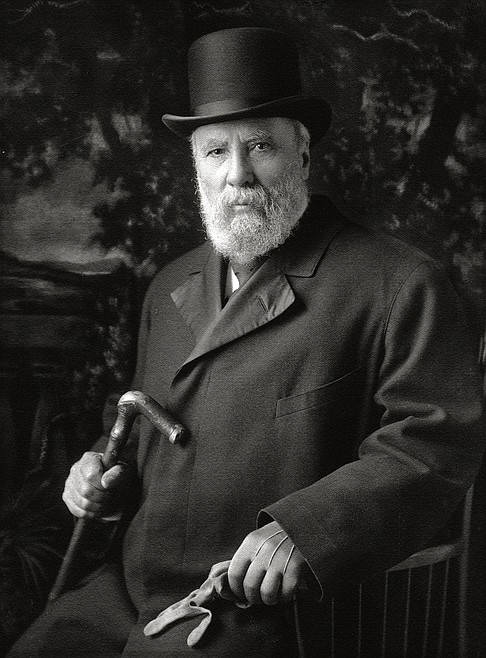 James Jerome Hill (September 16, 1838, Eramosa Township, Upper Canada (now Ontario) - May 29, 1916, St. Paul, Minnesota, U.S.), American railway entrepreneur and chief executive of the Great Northern Railway system.
Source: Daily Inter Lake
The commercial side of the De Lobel scheme presents, also, room for speculation, and there are those financiers who say they cannot see how, even though it were consummated, it would pay interest on an expenditure of perhaps half a billion dollars. A journey from the Occident to the Orient by rail, Baron De Lobel points out, would be a luxury that few with the money to spend could resist. But why from the Occident to the Orient by rail, say the scoffers. From New York one may now sail to Paris, comfortable in palatial quarters, within a week. From New York to Paris, by the De Lobel route, would be a journey they say that would tire even a locomotive. From New York to Seattle would take six days, from Seattle to Cape Prince of Wales, perhaps ten days, and through the tunnel, across the trans-Siberian road to St. Petersburg and thence to Paris, many more. Equipped on the Asiatic branch side with the very finest trains, the entire journey from New York to Paris could hardly be made within a month.
From Pacific Coast ports by way of the existing transcontinental roads, and thence by steamship to Europe, the journey could be made two weeks quicker than by the De Lobel route, but the fact is rightly pointed out that Siberia and Alaska and the Northwest Coast could be brought in closer contact and time saved in the journey between them, especially when ice blocks the northern seas and Vladivostok, Russia's only Far Eastern port, is closed to commerce.
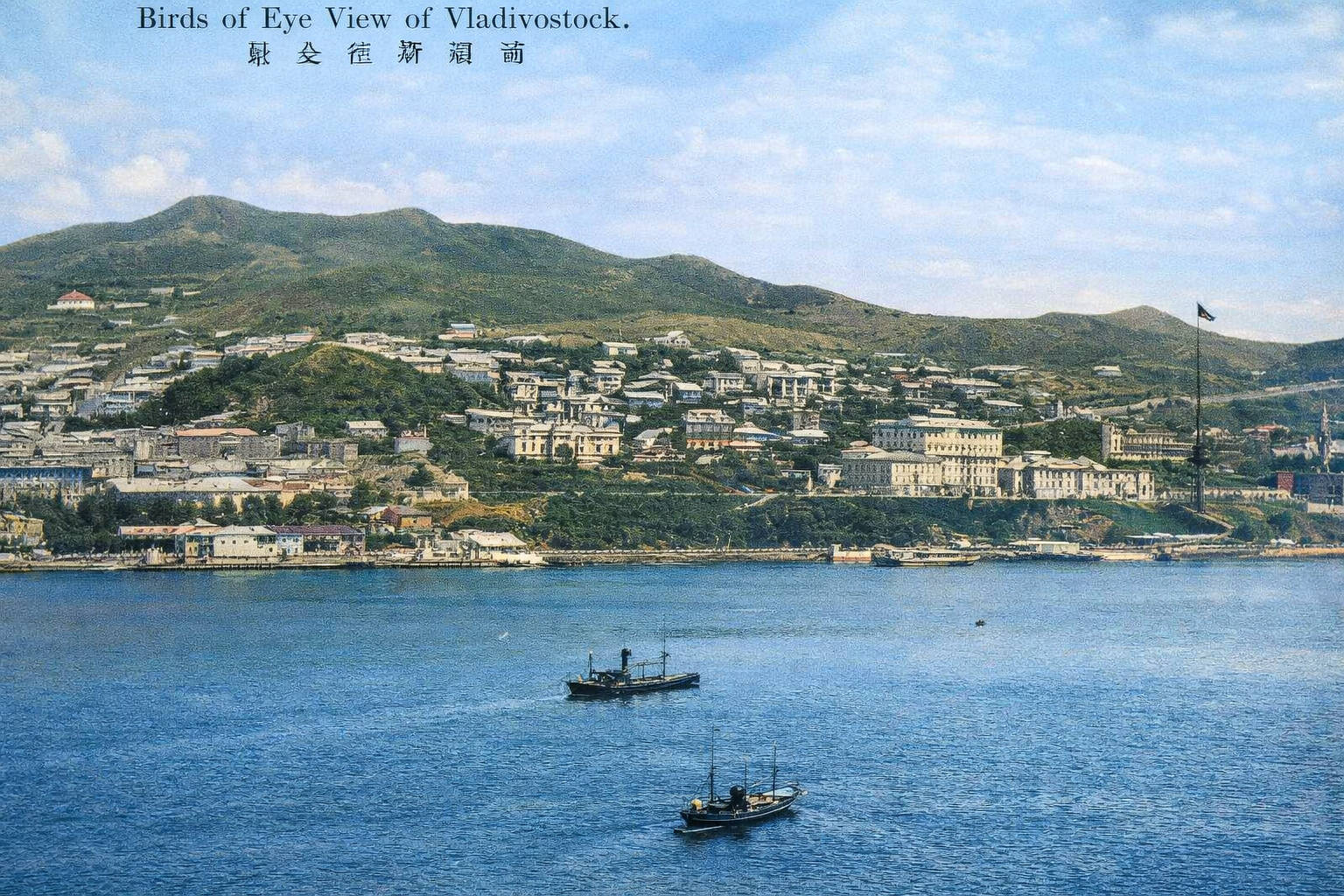 Russian sea port - city of Vladivostok. 1906.
Source: The San Francisco Sunday Call, Volume 100, Number 94, September 2, 1906
During the winter months ships battle in vain against the elements and activity ceases. Russia has lost Port Arthur, upon which she rested her commercial hopes, and on every hand bayonets bristle to keep her from the year-open sea. The trans-Alaskan-Siberian railway may yet give her a front place among the commercial nations; it may people the now half-deserted land that cost her so dearly in the recent war and it may fill her with the strength that not so long in the future-when civic honesty is hers and her people freed and fired with loyalty and love of country-will enable her once more to hurl defiance at the Island Empire.
This discussion makes for the strategic question involved in the proposed construction of the Bering tunnel, and of this more can be said. When the war between Russia and Japan came to an end, Japan's guns were thundering at the gates of Harbin. There was to take place, all agreed, the decisive battle of the campaign, but all were in error, for developments proved the decisive battle had been fought, and Russia was humiliated in defeat. Harbin marks the dividing of the trunk line of the trans-Siberian road into two branches, the one terminating at Port Arthur, the other at Vladivostok. Within a month the army massed by either of the belligerents could have been moved, were the railway completed to the Siberian end of the proposed De Lobel tunnel. Were hostilities unexpected a handful of men could sweep through the tube and standing on the American side be masters of the situation.
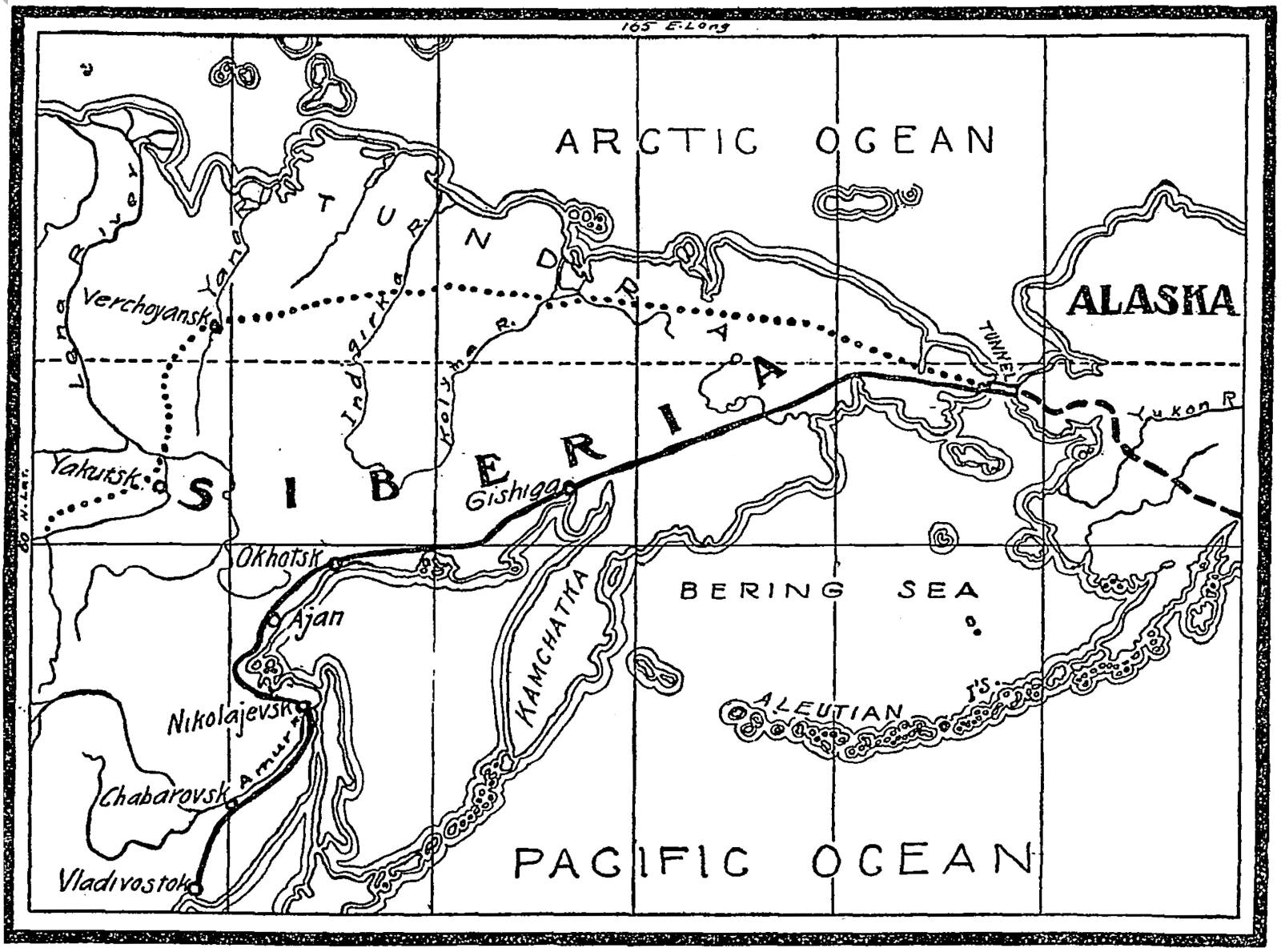 Map of proposed railroads in Siberia, Russia, 1906. The northern route: from the Bering Strait via Verkhoyansk toward Yakutsk. The southwestern route: from the Bering Strait toward Gizhiga, Okhotsk, Ayan, and Nikolayevsk, continuing toward Khabarovsk and Vladivostok.
Source: The New York Times
"For seven days and seven nights," an ancient writer penned, "the bridges across the Hellespont groaned and trembled beneath the human tide Asia was pouring into Europe." This was Xerxes' campaign against Greece, but, unfortunately for Xerxes, every man of the 2,300,000 that made up his legions lay down to die on Grecian soil, his skull cracked by a Grecian battle-ax.
America might not be so fortunate. A man of the daring and genius of a Genghis Kahn, the Bering tunnel in his possession, could, not alone for seven days and seven nights, but for seven years, pour a human tide from Asia into America-a yellow tide, heartless and terrible and bent on avenging the wrongs they have suffered from the powers and among which, to them, there is no distinction-all are white and all are alike. This is speculation that may savor of imagination only, but who can say that in the years to come the plan of a Frenchman may not lay the free Western land prey to the hordes of China?
Now, the financial end of this mighty scheme. Reports from Europe say that Baron de Lobel proposes capitalizing the trans-Alaskan-Siberian Railway Company at $300,000,000. He asserts that this sum will carry the plan to consummation; others say it cannot be done for less than $500,000,000. But when it comes to plans daringly conceived as this, Frenchmen can always be counted upon for support, even though their only dividend is the knowledge that they have gambled in a good cause. It was they who spent millions upon millions in the effort to construct the Panama canal, which the United States is now completing.
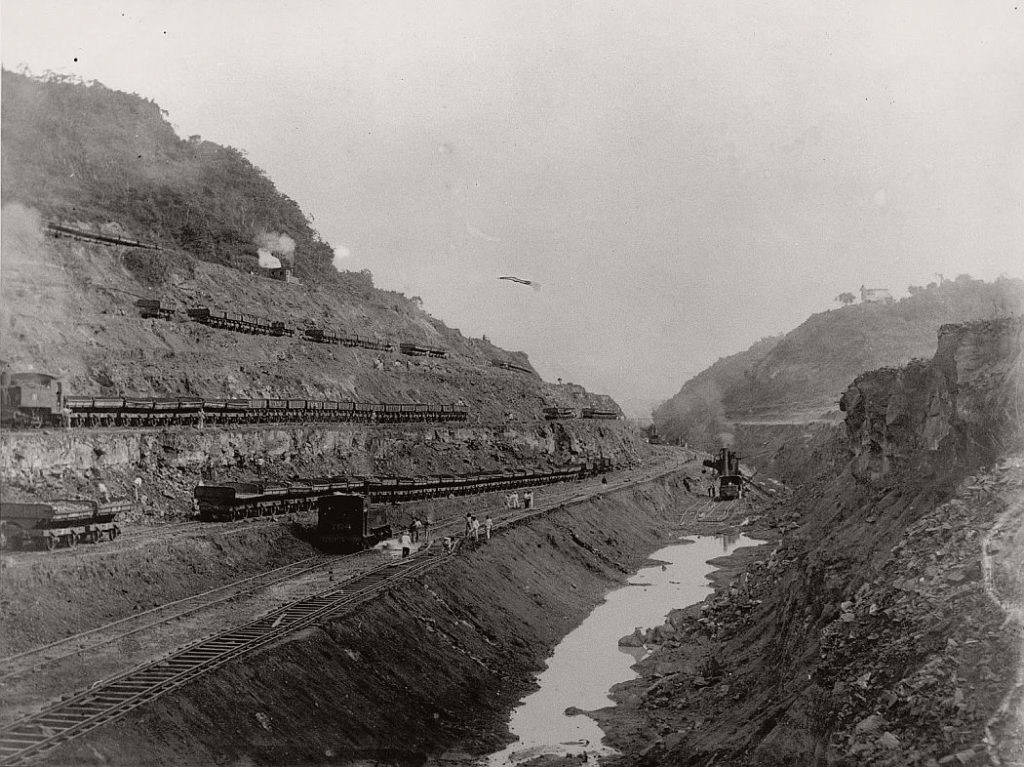 Culebra Cut was the most challenging 9-mile excavation site of the Panama Canal, cutting through the Continental Divide. Photo, 1904.
Source: MonoVisions
Perhaps it will be Frenchmen who will sink the first millions in the effort to tunnel beneath Bering Strait; then, financially embarrassed, abandon it to see Russia, rehabilitated, take up the work, and with half the money and none of the bloodshed a second war to win a year-open port would take, carry it to completion. Russia would be the greatest beneficiary of the De Lobel plan. In Siberia the fields are fertile and the mineral resources inexhaustible. The Czar has striven hard for their development, but bigotry and medievalism at home have wrecked his hopes and tottered his throne.
Regenerated, Russia will be rich in money and in workmen: to carry the trans-Alaskan-Siberian railway project to a successful conclusion would make but small inroads on her treasury. Then, perhaps, the limitless fields of America behind her, she will again wage war on Japan to wipe out the stains of Port Arthur and Liaoyang and Mukden, or perhaps, bent on peaceful ways, will pay all attention to commerce, stopping only long enough to pay honor to a man numbered among her greatest benefactors-Baron Loicq de Lobel, nobleman of France.
Discovered in archival records and transcribed by Fyodor G. Soloview (InterBering).

