BERING STRAIT TUNNEL OBSERVATION
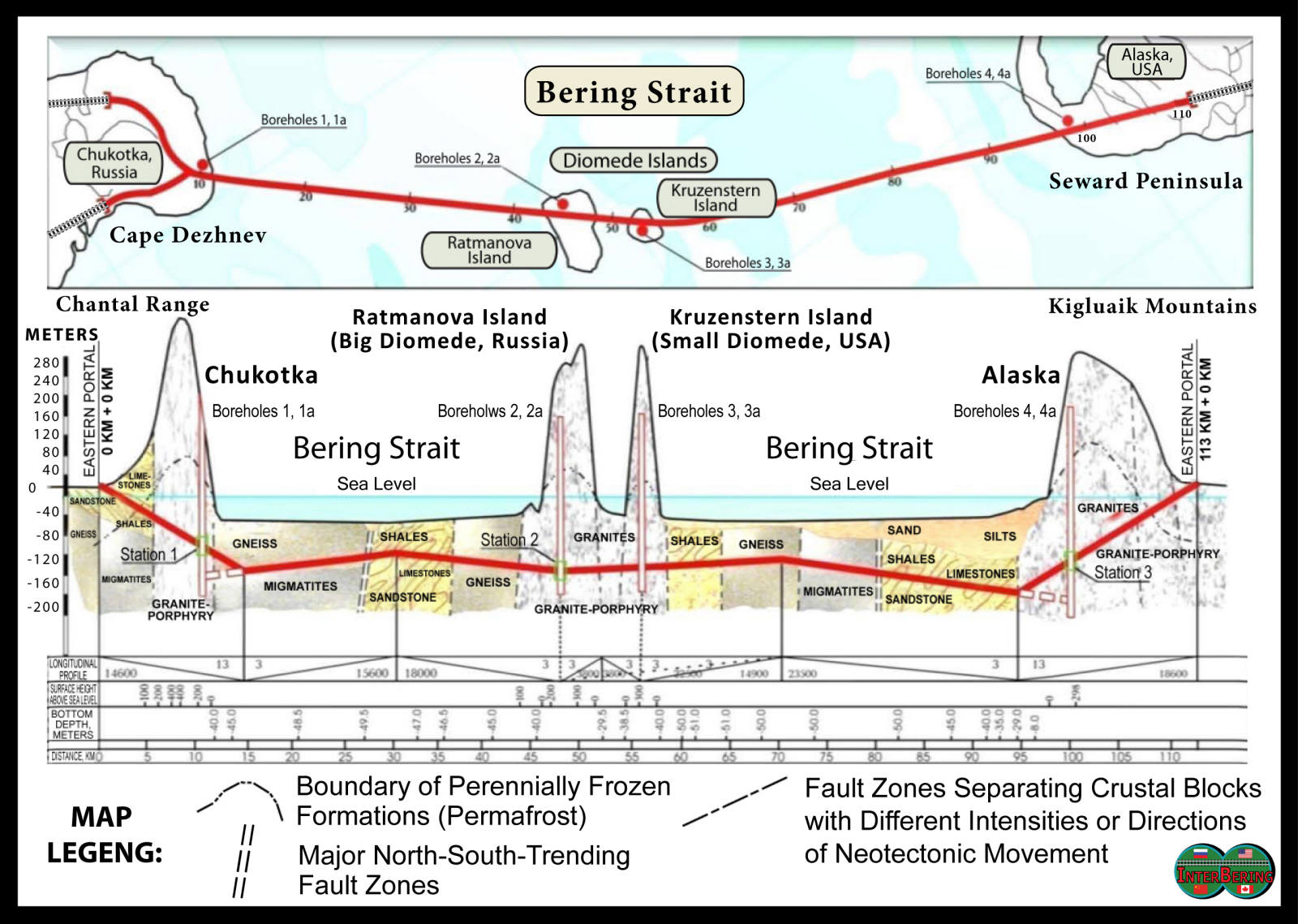
Proposed configuration – plan and profile cross-section of the Bering Strait railroad tunnel between Alaska (USA) and Chukotka (Russia), via the Diomede Islands (click image to zoom)
Source: Created by InterBering, LLC based on drawings by
Vladimir Arkadievich Brezhnev
(1985–1991, Minister of Transport Construction of the USSR; from 1991, President of Transstroy), prepared for the paper
“The Country’s Transport Construction Industry: Missing Large-Scale Projects”
for the International Conference on the Intercontinental Eurasia–America Transport Link via the Bering Strait, held during the International World Link Forum, Moscow, Russia, April 24, 2008; and based on the
Russian version, translated into English by InterBering, of the drawing
presented by
Victor Nikolaevich Razbegin,
Deputy Chairman of the Council for the Study of Productive Forces of the Russian Federation, at the International Conference
“Intercontinental Magistral Eurasia–America”, Yakutsk, Russia, August 17–19, 2011.
■ On the United States side the proposed Bering Tunnel would begin at Cape Prince of Wales in Alaska. The nearby city of Wales has a population of 156, paved roads and about 80 buildings including a large school, a general store and an airport. The other end of the undersea tunnel would emerge at the rural settlement of Uelen in Russia’s Chukotsky District.
■ The railway line on the Russian side would continue on to the microdistrict of Ozyorny, located 8 miles (13 km) north of the Russian town of Egvekinot – a seaport on Kresta Bay. From there, skirting the nearby gulf, the railway would go to the cities of Anadyr, Magadan, Oymyakon and finally Yakutsk. There it would connect to the existing Baikal-Amur Mainline and the Trans-Siberian Railway systems. China and other Asian and European countries would all be accessible.
■ On the U.S. side the rail tunnel could be connected with Fairbanks, Alaska through the cities of Buckland, Huslia and Tanana – or through the slightly longer southern route via the city Galena on the north bank of the Yukon River, and then on to Tanana and Fairbanks.
■ The Southern route may go in Alaska from Wales to Nome, Koyuk, in tunnels through the Kaiyuh and Kuskokwim Mountains to Nikolai, through the Alaska Range and passing the Susitna River to Willow, Palmer, Glennallen, and to Canada.

Proposed railroad between Yakutsk (Russia) through the tunnel under the Bering Strait to Alaskan cities Wales, Nome, Koyuk, Nikolai, Willow, Palmer, Glennallen, and further connection to Canada through Whitehorse and down to the contiguous United States of America (click image to zoom).
Source: Created by InterBering, LLC.
■ It is also proposed that the tunnel pass under both Little and Big Diomede Islands, where ventilation shafts and other facilities could be sited. Both Little Diomede (USA) and Big Diomede (Russia) have, in fact, been settled for centuries. Archaeological findings date back over two thousand years. Little Diomede has an Inalik Native village with a population of about 200 plus a high school, a store, a post office, a community hall and many residences.
The terrain of the Diomedes is similar to the fiords of Norway or the rolling grassy hills of Scotland. In wintertime, the surface of the Bering Strait itself is frozen.
■ Where the tunnels pass under America’s Krusenstern Island (Small Diomede), a railway station could be built allowing passengers elevator access to the island. A world-class hotel would provide them with a mid-Strait vista of the confluence of the Pacific and Arctic Oceans. A stay at this iconic hotel, along with a journey on the magnetic levitation train serving it, would surely become a tourist attraction in its own right. A similar facility could be created on Russia’s neighboring Ratmanov Island (Big Diomede).

■ The tunnel project will actually involve construction of three parallel tunnels under the Bering Strait connecting the U.S. and Russia, along with sections of railway linking to the rail systems on each of the two continents.
■ Both of the two double-deck main tunnels (each 54 feet / 16.5 meters outside diameter, 49 feet / 15 meters inside diameter) will accommodate two-way traffic between Alaska and Russia. Both tunnels will also include two levels of traffic: the bottom part will have a heavier railway for high-speed cargo and passenger rail traffic; an upper level will include space for magnetic levitation trains, one or two lanes for automobiles, and additional space for a future Airless Maglev Tube Transport system. Still other space at the right and left corners of the bottom level will be used for water, gas and oil pipelines plus electrical and fiber optic cables.
According to Dean Workman, vice president of the conveyor division at the Robbins Company, “large-diameter tunnels are actually easier to work with than small-diameter tunnels because you have much more room in the tunnel.” (Tunnel Business Magazine, June 2017, page 18.)
■ A third tunnel (23 feet / 7 meters outside diameter, 18 feet / 5.5 meters inside diameter), built between the two main tunnels, will provide emergency access corridors to each main tunnel at regular intervals along the entire route. It will also house a road for use by emergency and maintenance vehicles.

Design sample of two one-deck, single-line traffic tunnels under Bering Strait (click image to zoom).
Source: Cooperative design architectural company A-2, Novosibirsk, Russia.
■ The length of each tunnel will be about 74 miles / 119 kilometers or more, which includes the width of the Bering Strait (64 miles / 103 km) plus a distance not less than 5 miles / 8 kilometers inland on each coast. This will result in better access for trains utilizing the tunnels.
■ Completion of the entire project will take 12–15 years, at an estimated cost of $35 billion.
■ Excavation of the undersea tunnels will produce crushed basalt gravel (approximately 50 million cubic meters / 55 million cubic yards) which can be used in the construction of railway beds extending beyond each end of the tunnel. The quantity of this gravel product will be sufficient to lay a rail bed 20 inches (51 cm) deep at a width of 41 feet (12.5 meters), extending 4,873 miles (7,843 km) in length. This will cover the distance from the Bering Strait to Canada in America and much of the necessary access railway in Russia.
■ This gravel by-product also explains why construction of the interhemispheric North America – Eurasia railroad project should start with the tunnel portion. Moving the resulting crushed stone from the tunnel excavation site along future access rail beds will keep down the cost of their construction.

Gravel bed under Alaska railroad rail tracks near Girdwood, Alaska (click image to zoom).
Photo: Fyodor Soloview.
■ Construction will go on 24 hours per day. The tunnel workers will be laboring around 100 feet (30 meters) below sea level in an environment with a steady temperature of 25-30° Celsius (77-86° Fahrenheit). The cooling system inside the tunnels will not therefore require air conditioning because cool air can simply be vented in from the outside.
■ To house workers, engineers, equipment and materials, huge underground depots will be constructed at the entrances to the tunnels. These will be designed to cover work areas from summer rain or winter snow. Warm tunnel air can be used to help keep depot temperatures moderate.
■ If equipped with high-speed trains run by magnetic levitation, tourists will be able to cross between the U.S. and Russia in just 15–20 minutes, with further links to Alaskan international airports in Fairbanks and Anchorage.

Stingray-Inspired Maglev Train.
The future of public transportation is likely to be shaped by less energy-consuming solutions, including magnetic levitation already in use in Japan, China, and South Korea.
Designer: Darina Shi, Saint Petersburg, Russian Federation.
■ Extending the proposed underwater tunnel inland, beyond the 5–10 miles envisioned, may make economic sense. The combination of railways, highways and utility lines may actually be cheaper to build and maintain below ground than above ground in Arctic climates.
■ First of all, instead of building a series of roads and railways meandering along the slopes and foothills of mountain ranges, interspersed with mountain tunnels and bridges – a continuous tunnel could provide the shortest distance between points. The cost of constructing multiple surface tunnels might be more than that of a continuous underground tunnel.
■ Secondly, every structure on the surface would need to be maintained during long Arctic winters with frequent snowfalls. Far less winter expense would apply to underground infrastructure. The profitability of the interhemispheric railroad between North America and Asia would depend on continuous and on-time circulation of trains carrying cargo and passengers.
■ The third, and probably the most costly expense in building roads and railways in the Arctic is the presence of permafrost and the continuous freezing and unfreezing of the ground beneath thousands of miles of road or track. Tunneling underground avoids all of this, while simultaneously providing space for utility lines and pipelines.

Village of Wales on the low coast of the Bering Strait tucked at the foot of the hill separating it from Tin City (click image to zoom).
Photo: Craig Scola.
■ Underground transportation also carries the advantage that trains carrying passengers or cargo will require less inside insulation and heating. Cargo trains carrying containers with delicate electronic goods, plastics or liquids will be better protected from harsh outside conditions.
■ Yet another element in lowering the cost of construction by tunneling would be avoiding environmental problems. Less ecological regulation comes into play in planning a tunnel route, while a surface railway project might be delayed for years in paperwork to get regulatory approval.
■ With all the above advantages in mind, the delivery of construction equipment and materials could be accomplished using the existing Alaska Railroad and the seaports in Anchorage and Valdez. The city of Fairbanks could become the starting point of a new era of global transportation, with the State of Alaska acknowledged for helping bring about a new world transportation infrastructure.

Potential transshipment facility layout including an axle-gauge changeover point at the Alaska tunnel entrance.
Author: Thomas Scholler, Fribourg, Switzerland. Transfer Station at Alaska Portal. Concept Study on the Electric Power Supply of the Bering Strait Tunnel.
Whether the proposed railroad tunnel is limited to the Bering Strait or extends along the route to Fairbanks, or whether it is built strictly with private funding or includes State and federal monies – it requires capital now to begin feasibility studies and to properly survey the proposed transportation corridor.
As all this could take up to 15 years to achieve, promotion work cannot begin soon enough.
If you are contemplating investment in this project, please contact us now at interbering@gci.net or follow the instructions on our website’s InterBering Investment Proposal page.

Fyodor Soloview, President InterBering, LLC (standing) receiving a letter of support to construct the Russia-US railway from the Deputy Head of Technical Policy of JSCo Russian Railways Victor Alferov on August 15, 2014.
Source: InterBering Archive.
The Alaska Railroad Corporation should also apply for federal funding to extend the railroad to the west, through Alaska’s interior and up to the Bering Strait – with the objective of continuing to Russia via the Strait. The ARC could thus open vast areas of the State containing mineral deposits, human resources and added tourist attractions.
The ARC experience in building and maintaining railroads using State and federal funds, together with InterBering’s links with private investors, Russian railroad construction companies and Russian government organizations, can together bring about a new and exciting phase of Alaska state development.
The Alaska Railroad Corporation could help begin this by building the stretch of railway from Fairbanks to the Bering Strait. The Bering Strait Tunnel itself could be planned and constructed by other subcontractors having direct experience in tunnel construction.

Alaska Railroad train in Seward (click image to zoom).
Photo: Fyodor Soloview.
On the Russian side, the Bering Strait Tunnel could eventually connect to Russia’s future high-speed rail network, including the proposed Moscow–Kazan high-speed railway, a planned 772-kilometre line. According to earlier development plans discussed by Russian Railways and Chinese partners, this corridor was intended to become the first segment of a transnational high-speed railway linking Moscow and Beijing over a distance of more than 7,000 kilometres.

Russia’s first high-speed railway, Moscow–Saint Petersburg “VSM-1” (under construction; expected completion in 2028).
Source: Wikipedia – Russian high-speed rail lines, projected and under construction.
New High-Speed Train from China to US?
● MORE ABOUT INTERBERING
● CONTACTS
● FOR CONTRACTORS & DEVELOPERS
● ADVERTISING AT OUR WEBSITE
Recommended Historical Studies and Related Reading
To better understand how the Bering Strait crossing idea evolved over more than a century, we recommend reviewing the following historical studies, archival publications, and project library materials.