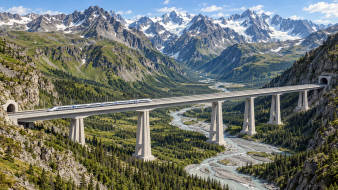
Léon Loïcq de Lobel was a French engineer, explorer, and early megaproject promoter whose name became closely linked to the first serious international attempt to advance a Bering Strait fixed link. Between 1898 and 1907, he pursued a transcontinental scheme to connect North America and Eurasia by rail via Canada, Alaska, Chukotka, and the Trans-Siberian Railway — including tunnels toward the Diomede Islands as the natural midpoint between the continents. By Fyodor Soloview, March 2026


by Scott Blair, ENR
November 11, 2014

InterBering, LLC
BERING STRAIT TUNNEL &
INTERNATIONAL RAILROAD DEVELOPMENT



English

Connecting people and continents.


--------------------------------------
--------------------------------------

--------------------------------------
America – Asia – Europe
International Railroad
 |
|---|
--------------------------------------
--------------------------------------
--------------------------------------
--------------------------------------
--------------------------------------
By Ed Peters, South China Morning Post — Oct. 4, 2020
John Arthur Lynch: An Early Advocate of a Bering Strait Connection. Irish-born American lawyer and Civil War officer John Arthur Lynch (ca. 1828-1900) was among the earliest documented promoters of transportation links between North America and Asia through Alaska and the Bering Strait region. Working from Washington, D.C., he petitioned Congress to investigate routes toward Russia, Japan, and China. His advocacy prompted an 1886 Senate bill and federal review, helping establish the Alaska-Asia transportation concept in the official U.S. record decades before detailed bridge and tunnel proposals emerged.
Fyodor Soloview, April 2026.
--------------------------------------

Crossing the Bering Strait
An unlikely American duo joins forces with Russian and Korean visionaries in an ambitious quest to connect North America and Eurasia through a railway tunnel beneath the Bering Strait.


They were the "Odd Couple" of the new millennium: George Koumal and Joseph Henri. This unlikely American duo joined forces with an eclectic group of Russian and Korean visionaries in a decades-long effort to connect North America and Eurasia through a railway tunnel beneath the Bering Strait. The proposed 85-kilometer tunnel and intercontinental railway would dramatically reduce transportation times between Asia and North America while creating a new corridor for railways, fibre-optic communications, electric power transmission, and other infrastructure linking the two continents. Yet enormous obstacles stood in the way, including political tensions, thousands of kilometers of missing railway lines, and a project cost estimated at tens of billions of dollars.
Interweaving spectacular Arctic landscapes with intimate documentary storytelling, The Strait Guys follows retired mining engineer and tunnel specialist George Koumal, founder and chairman of the Interhemispheric Bering Strait Tunnel and Railroad Group (IBSTRG), and his longtime colleague, Alaska attorney Joseph Henri, as they travel through Alaska, Russia, and beyond in search of support for one of the most ambitious transportation projects ever proposed.
During nearly three decades of advocacy, George and Joe helped bring the idea of a Bering Strait railway connection before government officials, engineers, investors, and transportation planners in several countries. Convinced that what they simply called "The Project" could strengthen economic cooperation and foster peaceful relations between nations, they devoted much of their later lives to keeping the vision alive.
More than a documentary about engineering, The Strait Guys is a human story about determination, friendship, and the willingness to pursue an extraordinary dream despite overwhelming odds. The film also serves as a historical record of the people who dedicated decades to promoting a fixed link between Asia and North America.
Tragically, George Koumal passed away on April 16, 2022, shortly before the film's public release. Joseph Henri survived long enough to see the completed documentary and remained a supporter of the project until his death on April 23, 2025. As a result, The Strait Guys has become both a documentary film and a lasting tribute to two of the most dedicated advocates of the Bering Strait connection.
Official website of the film by Rick Minnich:
https://thestraitguys.com/
Joseph Henri (left) and George Koumal
George Koumal, 80, retired mining and tunnel engineer, passed away on April 16, 2022, surrounded by his family. Born and educated in the former Czechoslovakia, he immigrated to the United States with his wife Alena in 1969 and eventually settled in New Jersey. During a distinguished engineering career, Koumal worked on major mining and infrastructure projects in the United States, Europe, and Africa, and received several U.S. patents related to mining technologies. In 1993, he founded and later served as chairman of the Interhemispheric Bering Strait Tunnel and Railroad Group (IBSTRG), an international nonprofit organization dedicated to promoting a rail connection between North America and Eurasia through a tunnel beneath the Bering Strait. For nearly three decades, George Koumal became one of the world's most visible advocates of the Bering Strait railway project. His efforts, together with those of Joseph Henri, Victor Razbegin, and other supporters, inspired the documentary film The Strait Guys (2022), which chronicles the long campaign to connect the continents through modern transportation infrastructure. (SOURCE)
PHOTO OF George Koumal by Fyodor Soloview. August 17, 2018. Anchorage, Alaska.


George Koumal
George Koumal and Joseph Henry


George Koumal, Fyodor Soloview, and Scott Spencer during filming for the documentary The Strait Guys, at Fyodor Soloview's residence in Anchorage, Alaska.
August 18, 2021.
Photo by Rick Minnich.


Written and directed by Rick Minnich, "The Strait Guys" is a feature-length documentary about a group of visionaries attempting to connect Russia and the United States through the world's longest railway tunnel beneath the Bering Strait. On August 2, 2022, the film was presented in Anchorage, Alaska, with the support of The Washington Times and the Family Federation for World Peace and Unification (FFWPU). Following the screening, guest speaker Joseph Henri — one of the principal characters featured in the documentary — shared his vision for the future development of the Alaska–Canada railway connection and the proposed rail link between the United States and Russia through the Bering Strait.
PHOTO OF Joseph Henri by Fyodor Soloview.
August 2, 2022 — Anchorage, Alaska.