


Port MacKenzie Rail Funding and Alaska’s Future Connection to North America
How a $249 million federal award could strengthen the foundation for a future Alaska–Canada railway
Sources and citations · Click any article image to enlarge it; use the arrows to browse.
A major advance for Alaska’s rail network
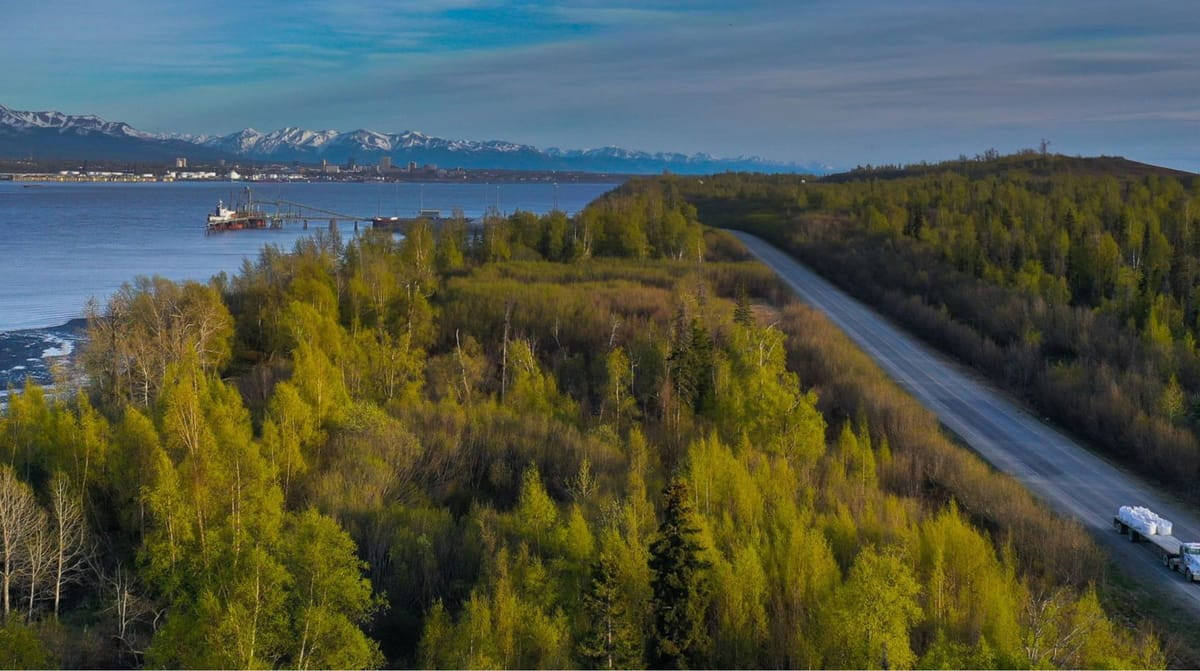
A federal award of $249 million has given Alaska a new opportunity to complete one of its longest-delayed transportation projects: the 32-mile Port MacKenzie Rail Extension. The line will connect the Matanuska-Susitna Borough’s deepwater port on Knik Arm with the Alaska Railroad’s main line near Houston, establishing a new route between maritime shipping facilities in Southcentral Alaska and customers in the Interior. [1, 2, 3]
The immediate purpose is practical: finish infrastructure that can move bulk commodities, construction materials, industrial equipment and military cargo. Its broader importance extends to the future shape of Alaska’s transportation network. A rail-connected Port MacKenzie could become a useful logistics asset for a later railway connecting Alaska through Canada to the contiguous United States—the North American connection advocated by InterBering.
That relationship must be understood accurately. The October award funds a domestic port rail extension. It does not authorize or finance an Alaska–Canada railway, a high-speed passenger line or a Bering Strait tunnel. Its significance for those longer-term concepts lies in the transportation capacity and development experience it could provide.
What was announced in Palmer
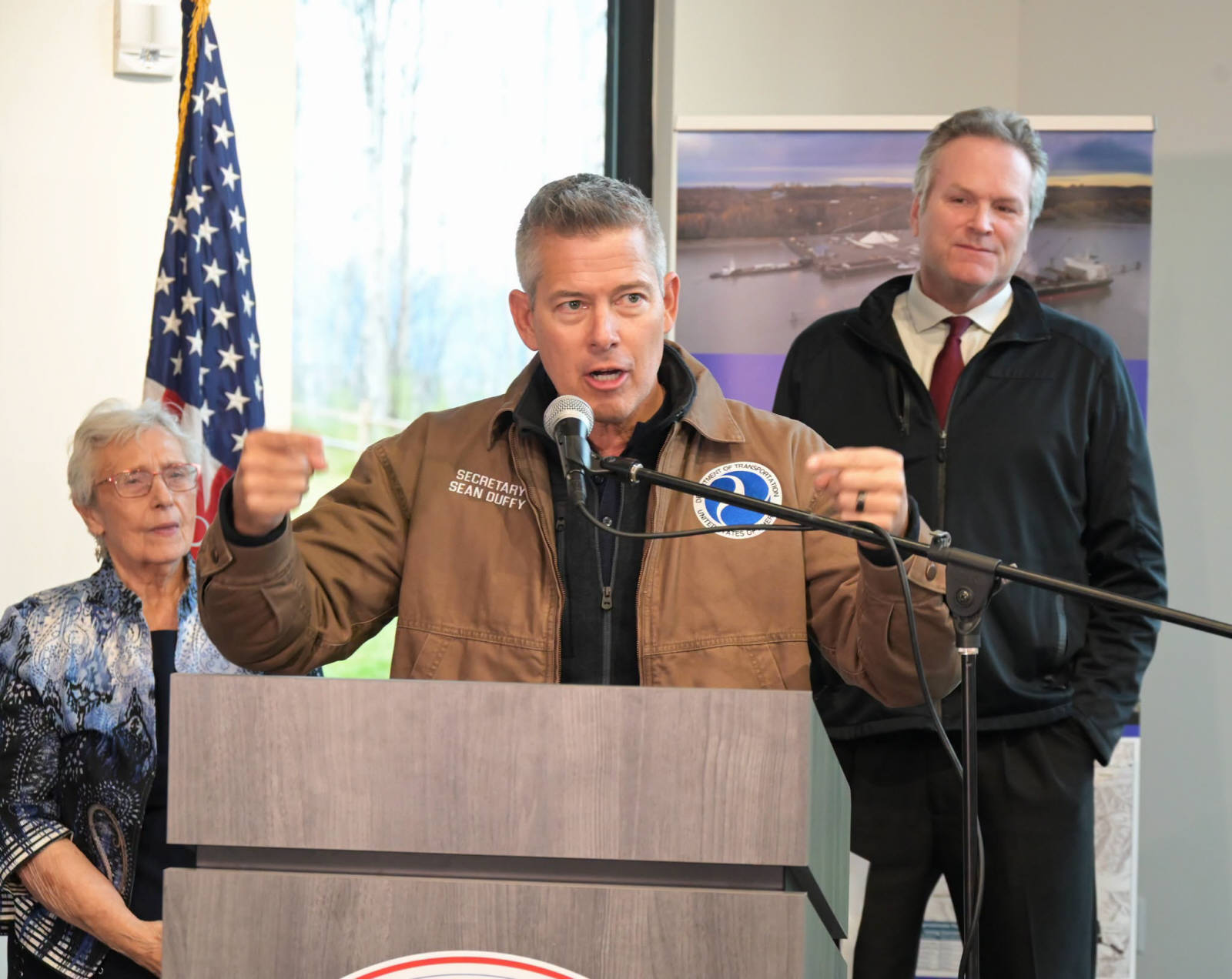
U.S. Transportation Secretary Sean P. Duffy announced the award on October 19, 2026, at the Gateway Visitor Center in Palmer. Participants included Governor Mike Dunleavy, Senator Dan Sullivan, Representative Nick Begich, Mat-Su Borough Mayor Edna DeVries and Alaska Railroad President and Chief Executive Officer Bill O’Leary. The railroad’s official release also identifies House Natural Resources Committee Chairman Bruce Westerman among those attending. [1, 3] See the Alaska Railroad’s official October 19, 2026 announcement [3].
The Federal Railroad Administration awarded the money to the Alaska Railroad Corporation through the Consolidated Rail Infrastructure and Safety Improvements program, commonly known as CRISI. Some announcements describe the investment as $250 million, a rounded figure; the reported grant amount is $249 million. The Department of Transportation describes the project as supporting Alaska’s mineral and energy transportation while improving rail performance and reducing shipping distances and costs. [3, 4]
The Alaska Railroad submitted the application with support from the borough. Alaska’s congressional delegation backed the request, including a July 21 letter supporting the full award. In August, FRA Administrator David Fink toured the corridor by air with railroad officials, viewing the construction already completed and the port district’s industrial potential. [2, 6]
Completing an investment begun two decades ago
The extension has a long history of state investment followed by a prolonged funding gap. The two contemporary reports describe its development beginning in the mid-2000s and work stopping during the 2016–2017 period as Alaska faced recession and budget constraints. Their dates differ slightly, but both describe a project left unfinished for approximately a decade. [1, 2]
Tim Bradner’s Mat-Su Sentinel report, republished by the Anchorage Daily News, puts previous state spending at approximately $180 million between 2005 and 2017. Alaska Business and the Alaska Railroad identify approximately $184 million in prior state appropriations for right-of-way acquisition, permitting, embankments and bridges. These are differently stated measures of earlier investment, rather than two separate amounts to be added together. [1, 2, 3]
With a shortfall exceeding $200 million, the borough explored other uses for the unfinished rail corridor, including conversion to a public access road. Meanwhile, Port MacKenzie continued serving barges and vessels carrying commodities such as cement and road salt, and improvements to the port itself continued. The rail project’s suspension therefore left a missing connection between an operating marine facility and the state’s existing railway. [1]
The new award creates an opportunity to put earlier construction to its intended use. It also illustrates the cost of interrupted infrastructure development: a partly built corridor cannot deliver the full transportation benefits expected from an operating railway.
What remains to be built
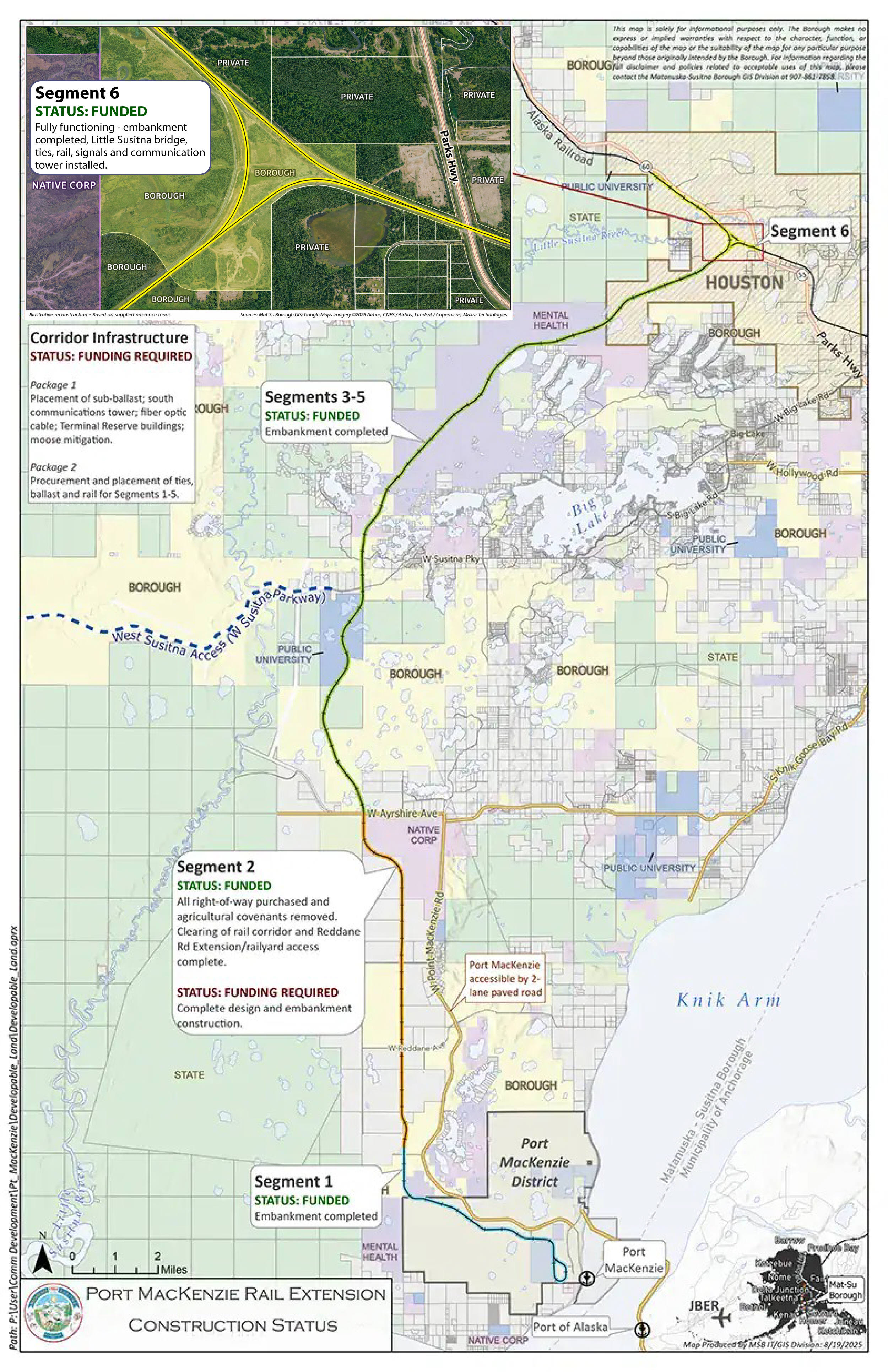
According to Alaska Business, approximately 25 of the planned 32 miles of railbed have been constructed, and six of seven bridges are in place. Considerable civil work is therefore complete, but an embankment alone is not an operating railroad. [2]
The remaining work includes completing approximately seven miles of railbed and installing ballast, ties and steel rail along the corridor. The reported scope also includes fiber communications, approximately five additional miles of siding and terminal track, a communications tower, telecommunications lines, terminal support facilities and a bridge over a roadway. Signals and operating systems must bring these components together into a functioning extension. [2, 3]
The connection branches from the main line near Houston, south of the Little Susitna River, and runs toward Point MacKenzie. Its purpose is to connect the port with the existing rail network; it does not cross Knik Arm directly to Anchorage. [1, 2]
How the completion package is financed
The estimated cost to complete the extension is $311 million. The $249 million federal award supplies approximately 80 percent, with a non-federal match of approximately $62 million supplying the remaining 20 percent. The railroad’s official announcement identifies borough in-kind contributions and cash from the Alaska Railroad and the Alaska Industrial Development and Export Authority, or AIDEA, as the sources of that match. [2, 3]
AIDEA’s October 20 announcement provides a more precise account of its role: the authority authorized up to $34 million from its Revolving Fund under a resolution approved June 17. This clarifies the first news report’s description of AIDEA covering roughly half the local share. Borough contributions include land and gravel, according to the Sentinel report. [1, 5]
The $311 million figure is a completion estimate, not the total historical cost of the project. Earlier state appropriations have already supported substantial work. Nor should the federal award be treated as money already fully spent or construction already completed: grant delivery, implementation and construction remain ahead.
Once finished, the extension will be owned, operated and maintained by the Alaska Railroad Corporation as part of its network. That operating responsibility is important because the line must function as an integrated service, with dispatching, maintenance and access to the rest of the railway. [3]
The proposed construction timetable
O’Leary told the Sentinel that work could begin in May and the extension could be completed as early as 2029. In the context of the October 2026 announcement, the anticipated May start means May 2027. These are conditional expectations rather than a guaranteed opening date. [1]
The timetable depends on the federal review of an earlier environmental study and the speed at which funding becomes available. Chief Operating Officer Clark Hopp said the project had previously obtained the necessary permits. Those earlier approvals do not remove the need to complete the review and administrative steps identified by the railroad. [1]
AIDEA’s account of the announcement likewise describes an ambition to move the grant forward by spring. The central milestone is therefore the transition from an announced award to a funded, executable construction program. [5]
Clark Hopp and the continuity of Alaska railroad expansion

Clark Hopp’s role in the renewed Port MacKenzie project reaches back well before the 2026 funding announcement. Alaska Railroad’s official biography records that, as Director of Special Projects beginning in 2011, he oversaw both the Port MacKenzie Rail Extension and Phase One of the Northern Rail Extension. His career thus provides a direct institutional connection between the two expansion projects discussed in this article. [13]
Hopp joined the Alaska Railroad in 2001 as a Capital Projects Manager and became Manager of Civil Projects in 2003. Before moving to Alaska Railroad, he worked for Transystems Corporation, providing project management services to BNSF and Union Pacific between 1995 and 2001. He earned a degree in Construction Engineering Technology from Iowa Western College and completed additional engineering coursework at the University of Nebraska. His experience therefore combined work for major continental railroads with the practical demands of developing infrastructure in Alaska. [13]
For InterBering, this history also has a personal documentary connection. In the 2012 interview arranged by Fyodor Soloview with Ukrainian journalist Maksym Drabok, Hopp appeared as Director of Special Projects. He described the years of environmental studies and consultation with Native communities needed before construction, emphasizing avoidance of impacts and protection of streams. His explanation showed why even a single major extension requires sustained preparation before visible construction begins. [11, 17]
The Alaska Railroad’s 2013 Northern Rail Extension fact sheet supplies the more detailed project chronology. Conceptual development began in late 2004; the environmental review advanced in 2005; the final Environmental Impact Statement appeared in September 2009; and the Surface Transportation Board issued construction and operating authority on January 5, 2010. Phase One construction began in July 2011. Hopp’s interview description of the 2005–2011 preparation period should therefore be read alongside the distinction between the 2010 federal authorization and the 2011 construction start. [16]
Phase One centered on the Tanana River crossing near Salcha, providing access to military training lands and infrastructure for subsequent railway development. The fact sheet identified three further phases: Moose Creek near North Pole to the crossing, the crossing to the Donnelly Military Training Area, and Donnelly to Delta Junction. All three were listed as unfunded in that 2013 document. This explains the strategic importance of Hopp’s special-projects assignment: it involved an initial crossing within a much larger proposed corridor, not a completed rail connection to Delta Junction. [16]
Hopp’s responsibilities broadened in 2013. The railroad’s February announcement named him to succeed Tom Brooks as head of Engineering when Brooks retired in May. That department’s remit included infrastructure design, capital projects, track and bridge maintenance, grant administration, and coordination with communities, agencies and utilities. Brooks publicly endorsed Hopp’s project-management record and readiness to lead the department. This promotion placed his extension-project experience within a wider responsibility for maintaining and developing the railway. [14]
He became Chief Operating Officer on January 1, 2018, succeeding Doug Engebretson. The appointment announcement described the position as overseeing transportation, engineering, mechanical, safety and grant administration functions at that time. President Bill O’Leary highlighted Hopp’s knowledge of infrastructure and operations, while Hopp emphasized investment in both railroad assets and employees as essential to future success. [15]
By the October 2026 announcement, Hopp was consequently speaking as a senior operating executive with firsthand management experience of the port extension’s earlier development. His statement that the project had previously obtained its necessary permits gains useful context from that history. The award renews a project he had helped oversee fifteen years earlier. [1, 13]
For InterBering’s examination of Alaska rail expansion, Hopp’s career illustrates the value of continuity between project planning, engineering leadership and operations. His documented contribution is the management and development of Alaska Railroad infrastructure; the wider Alaska–Canada and Bering Strait proposals remain separate initiatives. Recognizing his role helps explain how long-term expansion depends on experienced railroad professionals as well as funding decisions.
Coordinating the Houston rail extension with the proposed Parks Highway bypass
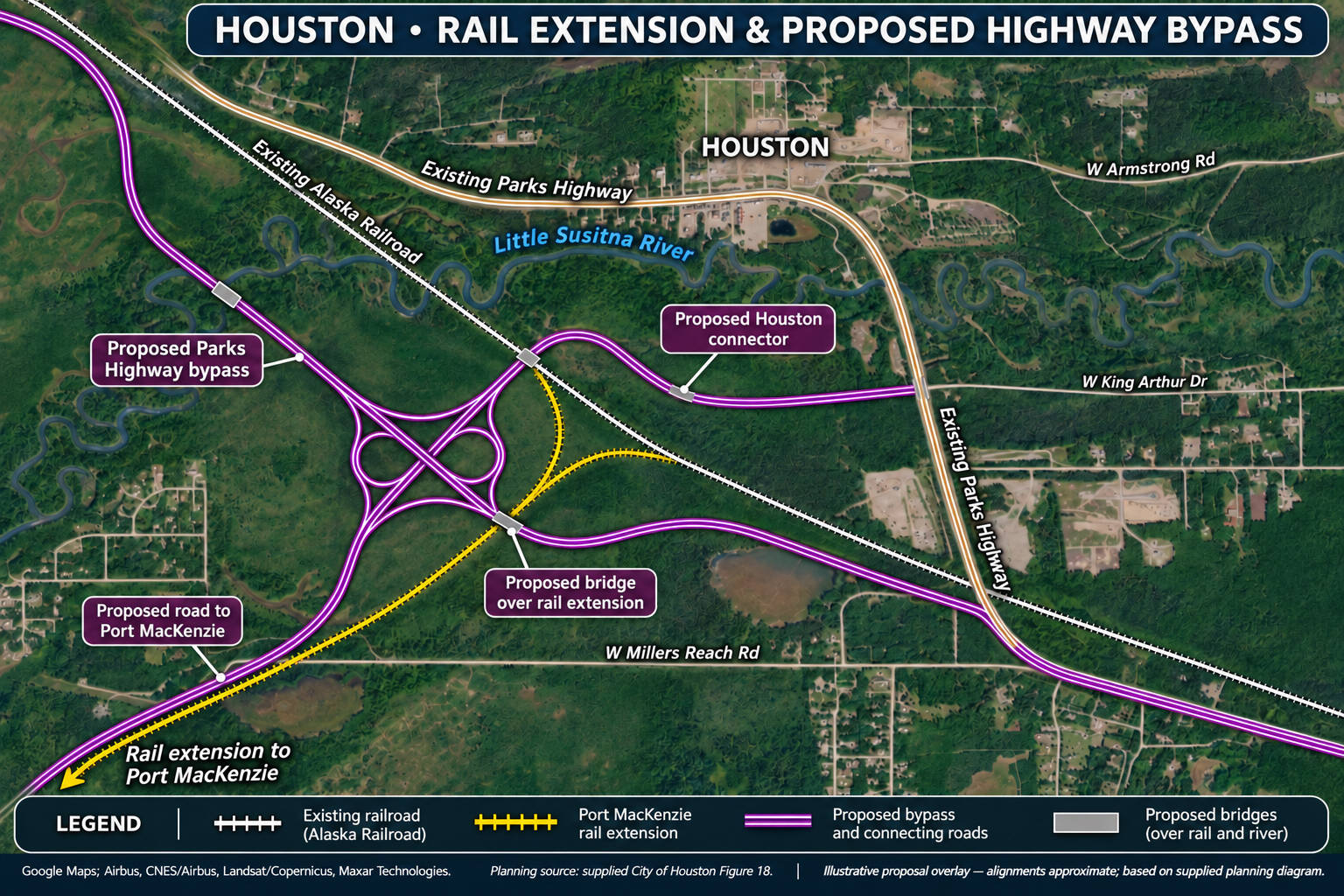
Completion of the Port MacKenzie Rail Extension should be coordinated with Houston’s long-standing proposal for a Parks Highway bypass. Near the junction with the Alaska Railroad main line, the rail corridor and the proposed highway crossing occupy the same planning area. Decisions about track elevation, bridge clearance and construction access should therefore be considered together before permanent work fixes the layout of either project.
The City of Houston Comprehensive Plan was adopted by the Houston City Council on September 8, 2016, under Ordinance 16-22, and by the Matanuska-Susitna Borough Assembly on February 21, 2017, under Ordinance 17-019. Prepared by R&M Consultants, Inc., with Van Le, AICP, as project manager, it describes a bypass envisioned since at least the early 1980s. The proposed route would run between Parks Highway Miles 56 and 60, generally alongside the railroad on its south or west side, and connect with the proposed Port-to-Parks highway. [18] See the Houston Comprehensive Plan [18] and Borough Ordinance 17-019 [21].
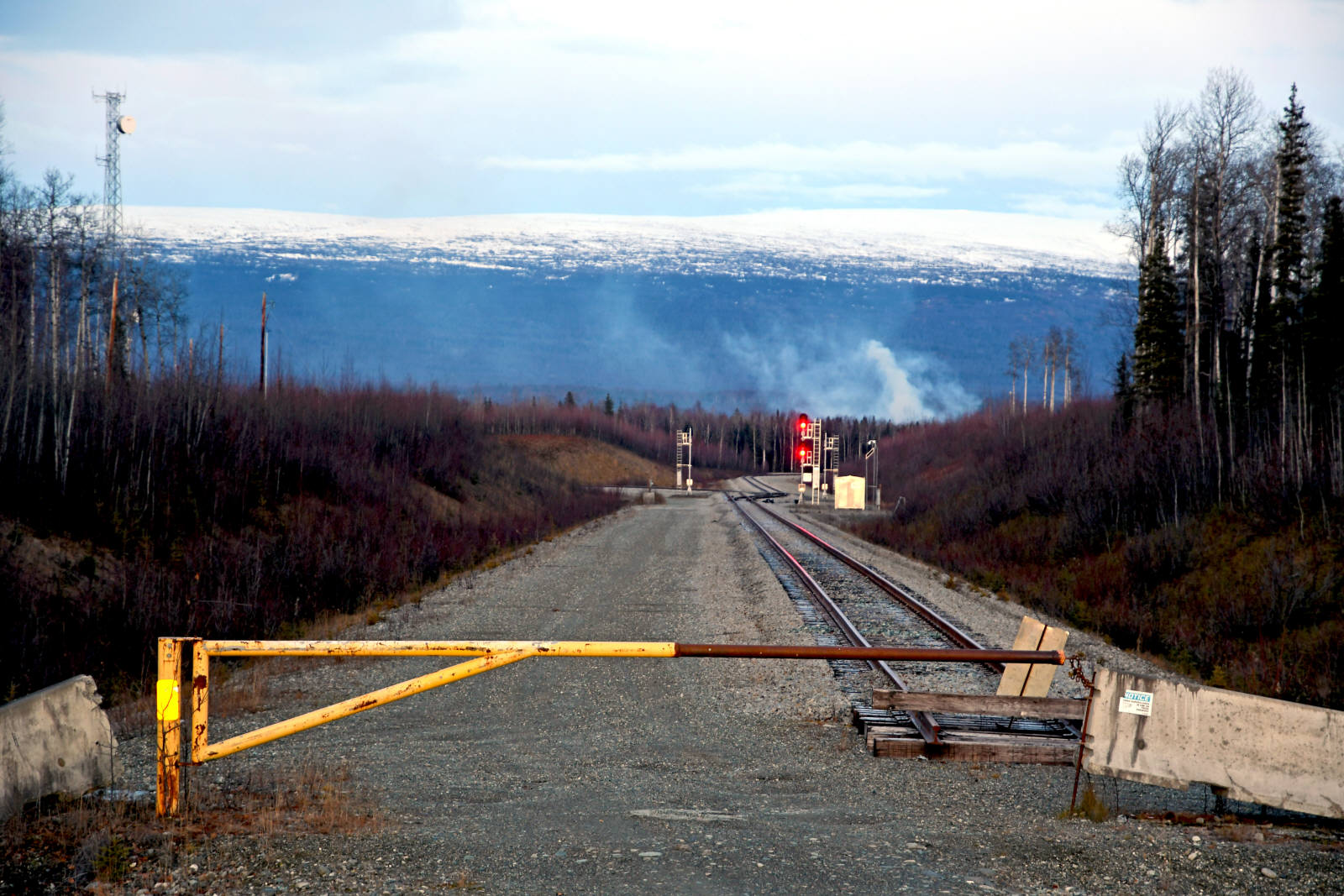
The rail end and the proposed crossing
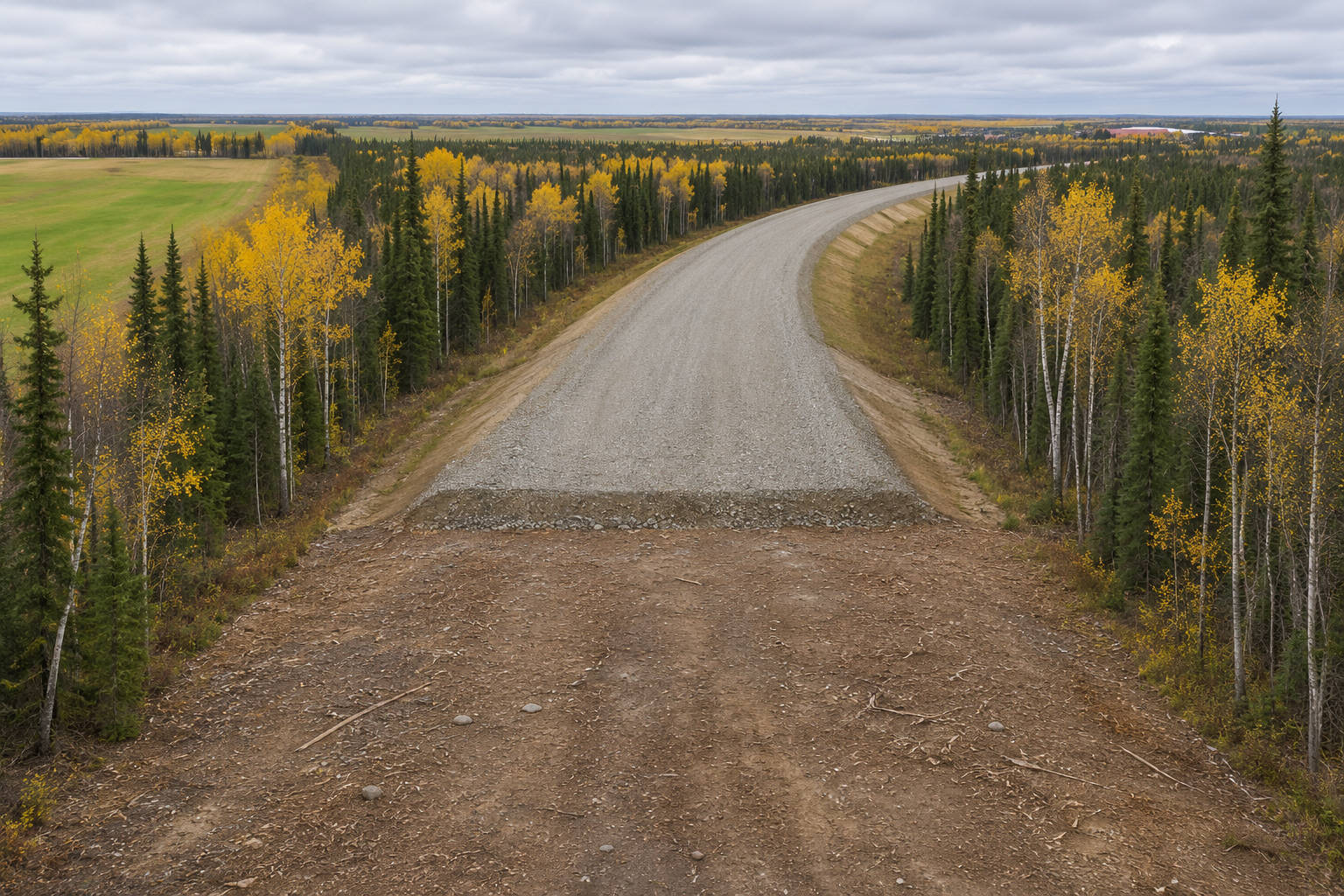
Fyodor Soloview’s recent photograph shows the physical end of the installed rails on the port extension approach near Houston. His comparison of the site with the bypass concept identifies this rail-end area as the location where the proposed highway bridge would cross the extension. It is consequently a critical point for coordination as track construction advances from the Houston end. The photograph documents existing conditions; the exact relationship between the track endpoint and future bridge foundations must be established through survey and coordinated design. [19, 20]
The comprehensive plan explicitly envisages an elevated Parks Highway with bridges over the Port MacKenzie Rail Link, the Little Susitna River, the railroad main line and new frontage roads. Its interchange concept occupies land bounded by the river to the north, railroad tracks to the east and south, and the city boundary to the west. Although a partial cloverleaf was initially recommended, the plan calls for a detailed evaluation of interchange alternatives before a final configuration is selected. [18]
Protecting both projects through coordinated design
InterBering recommends that the Alaska Railroad, Alaska Department of Transportation and Public Facilities, City of Houston and Matanuska-Susitna Borough jointly review this crossing before finalizing construction details in the affected area. That review should establish the highway and railway alignments and elevations, required clearances, bridge spans and foundation locations, drainage arrangements, utility conflicts and access for maintenance. It should also preserve sufficient space for the railway’s planned operating configuration and any justified future track requirements.
Construction sequencing deserves particular attention. Completing track without allowing for the future bridge could make later foundation work more difficult, require protective measures beside an operating railway, or lead to avoidable reconstruction. Conversely, placing highway foundations without an agreed railway layout could constrain track geometry or maintenance access. Coordinated design can reduce these risks even if the highway and railway are built under separate contracts and on different schedules.
The bypass proposal also has a community purpose. The comprehensive plan seeks to move through traffic away from Houston’s developing town center, reduce conflicts at driveways and intersections, and improve freight movement. It acknowledges that businesses along the existing highway could lose passing customers and recommends measures such as clear signs, suitable access connections and parking to support continued visits. Rail construction should preserve the ability to achieve these transport and town-center objectives. [18]
The adopted comprehensive plan provides a planning basis for coordination; it does not by itself establish that the bypass is funded, scheduled for construction or fixed to a surveyed bridge alignment. InterBering’s recommendation is to protect the proposed crossing now, so completion of the port railway does not create an avoidable obstacle to a future highway project.
Mining and industrial freight provide the immediate case
The borough has long promoted the port and railway as a way to attract industry, create employment and broaden its tax base beyond residential property. The Alaska Miners Association supported the extension early, even when some officials questioned its economic feasibility, and helped build support for initial state funding. [1]
A rail connection would allow mining businesses to bring supplies inland and move bulk products toward tidewater. Port land could provide storage so that outbound cargo can be accumulated before shipment. For heavy commodities, the ability to combine rail movement, stockpiling and vessel loading can be as important as the distance traveled. [1, 2]
The Sentinel reports borough studies suggesting that certain heavy-cargo movements through Port MacKenzie could cost 36 percent less than movements through Seward. It also reports that Fort Knox mine operators previously told borough officials that the connection could halve the cost of transporting bulk supplies to the mine. These are attributed estimates, not demonstrated savings across all freight categories. Actual results will depend on tariffs, cargo volumes, terminal handling and the origins and destinations served. [1]
AIDEA identifies additional industrial possibilities, including mineral processing and inbound project cargo. Its October release discusses a statewide mineral transportation study evaluating potential exports of approximately 6.6 million tons annually. That is a development scenario, not a commitment that such tonnage will immediately move through the new line. [5]
Energy projects and complementary port improvements
Alaska Business reports that the Alaska Gasline Development Corporation helped renew momentum for the rail extension by linking it to the logistics needs of a North Slope gasline. Port MacKenzie is being considered as a receiving point for 42-inch pipe, modules, equipment and other construction materials. [2]
The report describes Alaska Infrastructure Partners, a public-private partnership involving AGDC, Macquarie Capital and global rail developer Martinus. It identifies the Alaska Railroad, the Alaska Department of Transportation and Public Facilities, AIDEA and the borough as stakeholders. The private partners were advancing predevelopment work with a goal of construction readiness in 2027. These activities complement the new grant, but the report does not establish that every future contracting or financing arrangement has been finalized. [2]
A separate $34 million Port Infrastructure Development Program grant, reported in April as part of Alaska’s $115.4 million allocation, supports improvements at the port itself. These include a 110-acre staging and laydown area, a one-mile rail loop, expanded electric service and barge dock improvements. [2]
The port grant and AIDEA’s authorization of up to $34 million for the rail match are different funding items with the same approximate value. Keeping them separate is essential to understanding the project’s finances.
Presidential attention and the separate rail award
President Donald Trump’s Alaska visit occurred on October 13, 2026, six days before Duffy’s rail announcement. The White House published a same-day account of the visit, while the public schedule identifies the political rally in Wasilla. These were separate events in different Mat-Su communities. [7, 8]
The White House statement places the visit within the administration’s priorities for Alaska energy, minerals and Arctic security. It points to the January 2025 executive order on Alaska resource development and describes investments in energy and military infrastructure. This establishes the broader policy setting for the rail announcement. [7]
However, the White House statement reviewed for this article does not announce the $249 million Port MacKenzie award. The specific funding action is documented in the October 19 Department of Transportation and Alaska Railroad announcements as an FRA CRISI grant. It should therefore be described as an award made under the Trump administration, rather than as a separate rail funding order signed by the President at the Wasilla rally. [3, 4, 7]
Military logistics also form part of the project’s immediate justification. The supplied reporting describes growing interest in moving equipment efficiently between Southcentral ports and Interior installations. A further rail-served port could provide additional routing choices, although its practical defense value will depend on terminal capability and the connecting network. [1]
InterBering’s appeal to the White House before the award
On September 10, 2026, Fyodor Soloview, President of InterBering, LLC, addressed a letter to President Donald Trump urging the administration to complete Alaska’s unfinished railroad expansion and pursue a direct railway connection through Canada to the contiguous United States. According to Soloview, he submitted the letter through the White House online correspondence system and received an immediate standard acknowledgment thanking him for sharing his thoughts with the President. [11]
The letter concentrated on the Alaska Railroad’s Northern Rail Extension toward Delta Junction and Fort Greely and on the broader Alaska–Canada connection. Soloview presented the proposal as strategic national infrastructure, emphasizing military logistics, freight and resource development, passenger transportation and Alaska’s integration with the continental railway system. He also described his involvement in arranging a 2012 interview with Alaska Railroad officials and asked the President to consider announcing an examination of how to complete the unfinished work during his anticipated Alaska visit. [11]
A subsequent White House email dated October 1, 2026, addressed to “Dear Mr. Soloview,” thanked him for writing and sharing his thoughts. The copy supplied by Soloview discusses general administration priorities, including public safety, affordability and economic policy. It does not refer specifically to rail infrastructure, the Northern Rail Extension, Port MacKenzie or an FRA funding decision. It records a White House response to his correspondence, but does not establish that the President personally reviewed the proposal or that it was referred to transportation officials. [12] Read the October 1, 2026 White House response (PDF).
The correspondence preceded the October 13 presidential visit and the October 19 Port MacKenzie grant announcement. This chronology documents InterBering’s advocacy for expanded Alaska rail infrastructure before the award. Whether the September appeal contributed in any way to the administration’s thinking remains unknown. The materials available for this article do not support attributing the grant decision, either partly or wholly, to Soloview’s letter.
The distinction between projects is also important: the September letter did not specifically request funding for Port MacKenzie. Moreover, the Alaska Railroad’s grant application and the congressional delegation’s July 21 support letter preceded Soloview’s September submission. The port award therefore emerged from an already established funding effort. InterBering’s correspondence belongs in the wider record of advocacy for Alaska rail development; any direct influence on this particular award would require further evidence. [6, 11, 12]
Why this matters to an Alaska Canada connection
For InterBering, the principal long-term question is how useful Alaska infrastructure can support a future connection to the continental rail system. The Port MacKenzie extension would improve access within Alaska, while a new cross-border corridor would address a different missing link: the overland railway connection through Canada to the contiguous United States.
The two investments could be complementary. If a future Alaska–Canada line connects with the Alaska Railroad, a rail-served Port MacKenzie could become one of the marine gateways available to that larger network. Construction materials arriving by sea could potentially move inland by rail, while regional exports could gain another route to ocean shipping. These are potential functions, not traffic commitments contained in the present award.
This suggests a useful planning principle: develop facilities with a credible present-day purpose while preserving options for later connections. A port spur need not wait for an international railway to justify its operation. At the same time, terminal layouts, industrial land reservations and junction capacity can be considered with future expansion in mind.
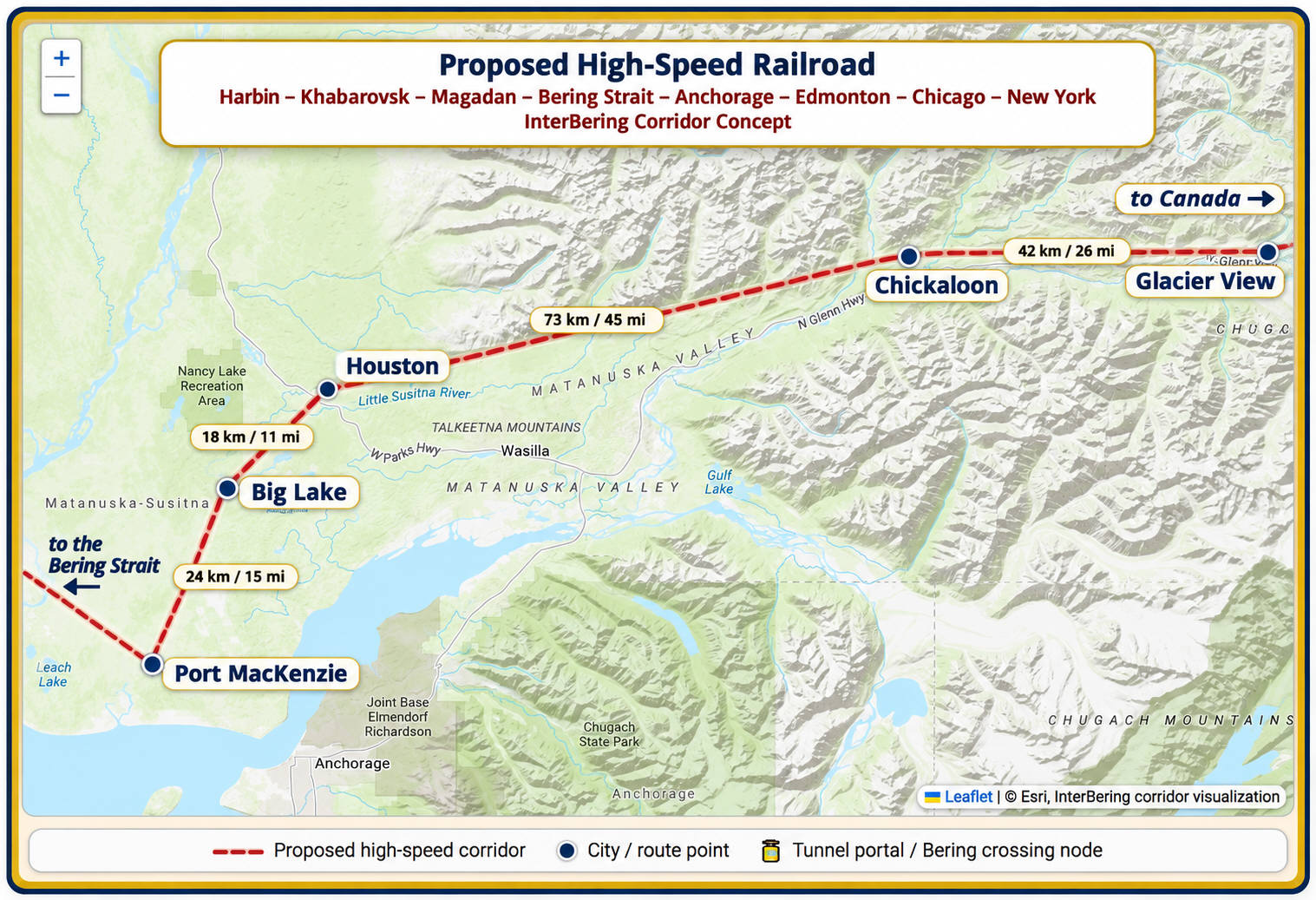
Port MacKenzie terminal loop within the InterBering vision
The terminal loop is the port-end component of the Port MacKenzie Rail Extension, intended to connect railway operations with cargo handling and marine transport. Alaska Business describes a one-mile loop designed to accommodate a 110-car train for unloading. Its usefulness depends on completing the railway to Houston and providing the track, signaling and terminal facilities needed to move freight safely between trains, storage areas and vessels. [2, 3]
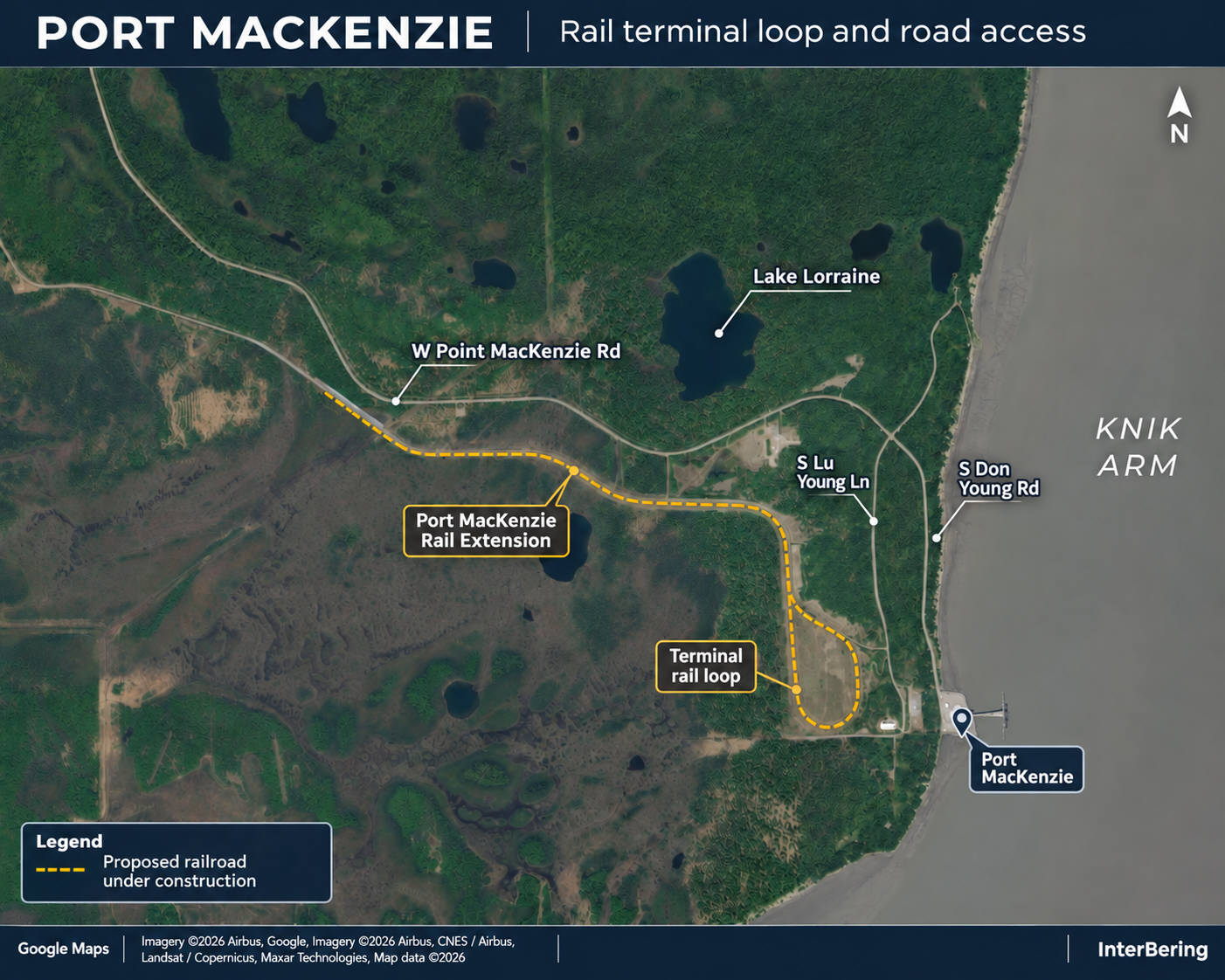
The satellite view shows how the approach corridor, cleared terminal area, roads and waterfront facilities relate to one another. Together, these elements could support transfers of bulk commodities, construction materials and industrial equipment. The visible railbed and clearing do not establish that tracks have been installed or that the loop is operating; the map illustrates the terminal setting rather than an as-built railway plan.
As the extension moves toward completion, terminal design should coordinate train length and cargo handling with storage areas, truck circulation, dock access, drainage and room for expansion. The objective is an efficient connection between railway operations and the working waterfront, with enough space to handle cargo without obstructing other port activities.
Anchorage–Edmonton high-speed rail before a Eurasian connection
Port MacKenzie’s potential role in InterBering’s vision begins with a North American railway. A proposed high-speed connection from Southcentral Alaska through Canada to Edmonton could be developed as an earlier stage, before any railway across the Bering Strait to Eurasia. Such a line would require its own feasibility studies, demand assessment, international agreements and financing; its potential usefulness should be evaluated independently of a later intercontinental connection.
For residents of Alaska and Canada, the immediate purpose would be practical passenger travel between Anchorage and Edmonton, rather than waiting for a future connection to Asia. Anchorage and the surrounding Mat-Su communities would form the Alaska end of the proposed service, bringing together travelers visiting family, conducting business, studying or exploring the region. A passenger station serving Anchorage and convenient connections from nearby communities would be essential to making the railway useful in everyday travel.
A possible day journey between Alaska and Alberta
InterBering’s home-page concept uses an illustrative Anchorage–Edmonton distance of approximately 1,510 miles (2,430 km) and a maximum operating speed of about 220 mph (350 km/h). At a constant 350 km/h, that distance would take just under seven hours; adding approximately one hour for stops and slower running produces the concept’s roughly eight-hour journey. This is an optimistic planning illustration, not a timetable or an engineering forecast: the actual alignment, sustained average speed, mountain sections, station stops and border procedures would determine the journey time. A service could be considered on its own merits before any Bering Strait connection. [34]
A route through Yukon, British Columbia and Alberta could offer views of mountain ranges, river valleys, forests and northern plains. Depending on the eventual alignment and schedule, passengers could choose a daylight journey for the scenery or, if offered, an overnight service with sleeping accommodations. The attraction would combine a direct international journey with the experience of traveling through northern landscapes.

A through train could allow passengers to remain aboard for the journey between Alaska and Canada. How immigration and customs checks would work would require agreement between the two countries. Onboard inspections or checks before departure could be examined, but uninterrupted travel through the border cannot be assumed. Passenger documents and entry requirements would need to be incorporated into the service design.
Edmonton could also become a connection point for future routes farther into Canada and the contiguous United States. InterBering’s wider concept considers destinations including Sacramento, New York, Dallas and Florida. Such onward journeys would depend on additional railways, compatible services and border arrangements; their distances and travel times would need to be calculated from actual proposed routes. For Alaska and Canada, the first question is whether an Anchorage–Edmonton service could attract enough passengers and deliver sufficient regional benefits to justify its development. [34]
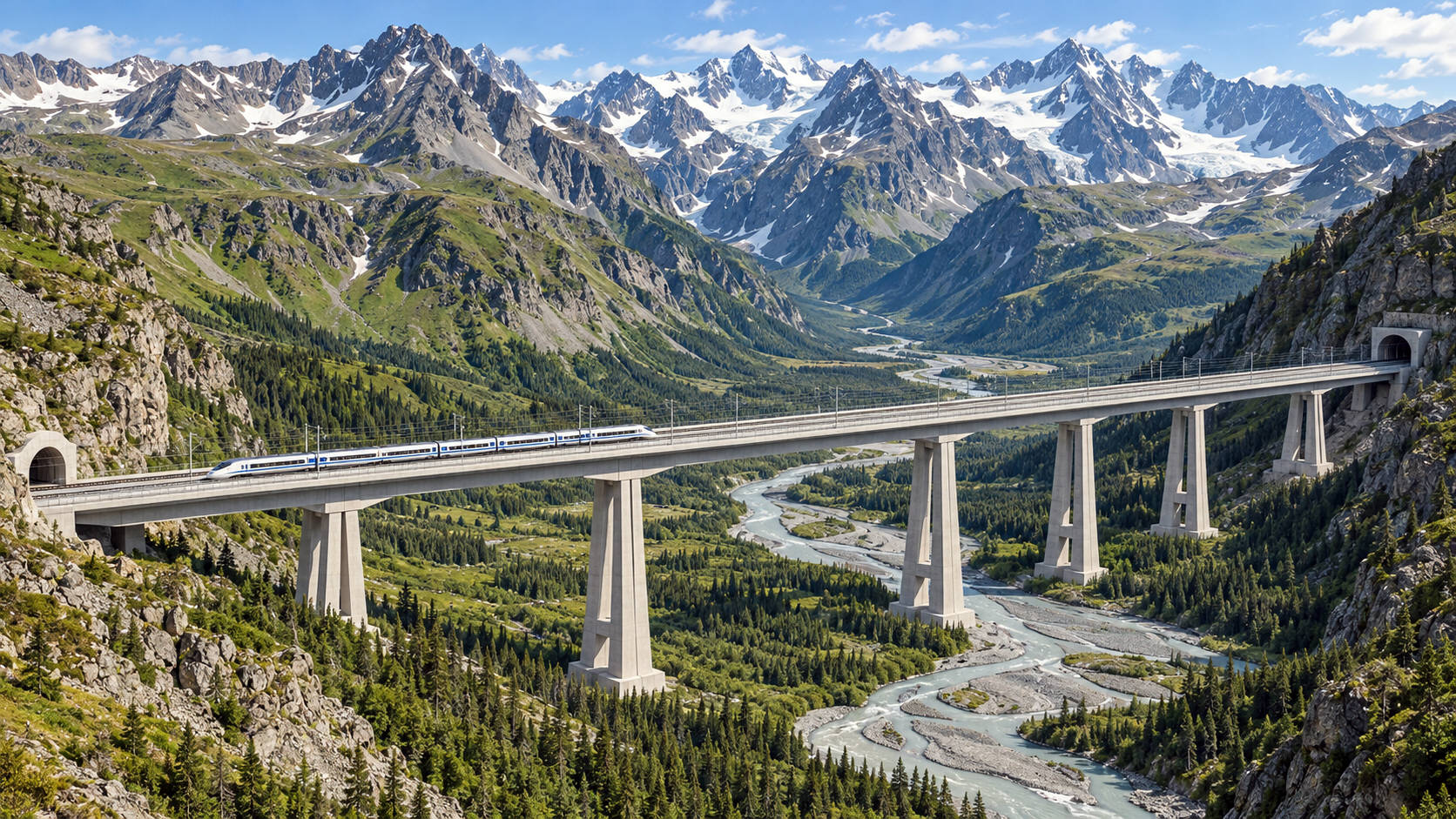
Why a Port MacKenzie depot would matter to passengers
A dependable passenger service needs more than stations and running tracks. Trains require cleaning, inspections, repairs, maintenance and secure storage between journeys. A substantial depot in the Point MacKenzie area could provide these functions for a future Anchorage–Edmonton fleet, helping prepare trains for scheduled departures and maintain their reliability. The depot would support passenger service; its location would not, by itself, make it the principal boarding station for Anchorage travelers.
In this concept, the wider Point MacKenzie area surrounding the port is a candidate for a substantial high-speed rail depot, with train storage, inspection and maintenance buildings, servicing facilities, staff access and space for expansion. Land for such a depot should be considered early, alongside the conventional freight terminal. The precise site and acreage have not been established: ownership, terrain, drainage, environmental conditions, utilities and the future HSR alignment would all need evaluation. The existing freight-loop area should not automatically be treated as the selected HSR depot site.
The relationship between the depot, the main HSR route and an Anchorage passenger station would therefore need to be planned together. Any proposed Knik Arm bridge or tunnel would have to be assessed for its actual transport function. A highway crossing could improve access for workers, supplies and passengers using road connections, while a railway crossing would require a specific rail design. A road-only crossing would not itself provide the HSR track connection to Anchorage.
The conventional Alaska Railroad could help build that future system. Once the port extension is complete, it could carry aggregate, steel, cement, machinery and other supplies to construction staging areas at Point MacKenzie, supporting depot buildings, access roads and associated infrastructure. Materials arriving by ship could also be transferred into the regional construction supply chain. These are potential construction-logistics uses, not cargo commitments in the present grant.
Conventional freight and high-speed passenger operations would retain different technical requirements for track geometry, signaling, capacity and terminals. A shared development area could support coordinated logistics without requiring high-speed trains to use the freight loop. InterBering’s longer-term border and customs concepts also identify the port area as a possible location for logistics and inspection functions, but those additional functions are not prerequisites for examining an Alaska–Edmonton service. [9, 10]
This gives Port MacKenzie a possible role in the travel plans of Alaskans and Canadians well before a railway reaches Eurasia: conventional freight rail could supply construction, a purpose-built depot could service passenger trains, and a separately designed high-speed route could connect the Anchorage region with Edmonton. Each element would need to be justified and coordinated, but the passenger benefit would be a North American connection in its own right.
Connecting the depots with Anchorage and the Interior
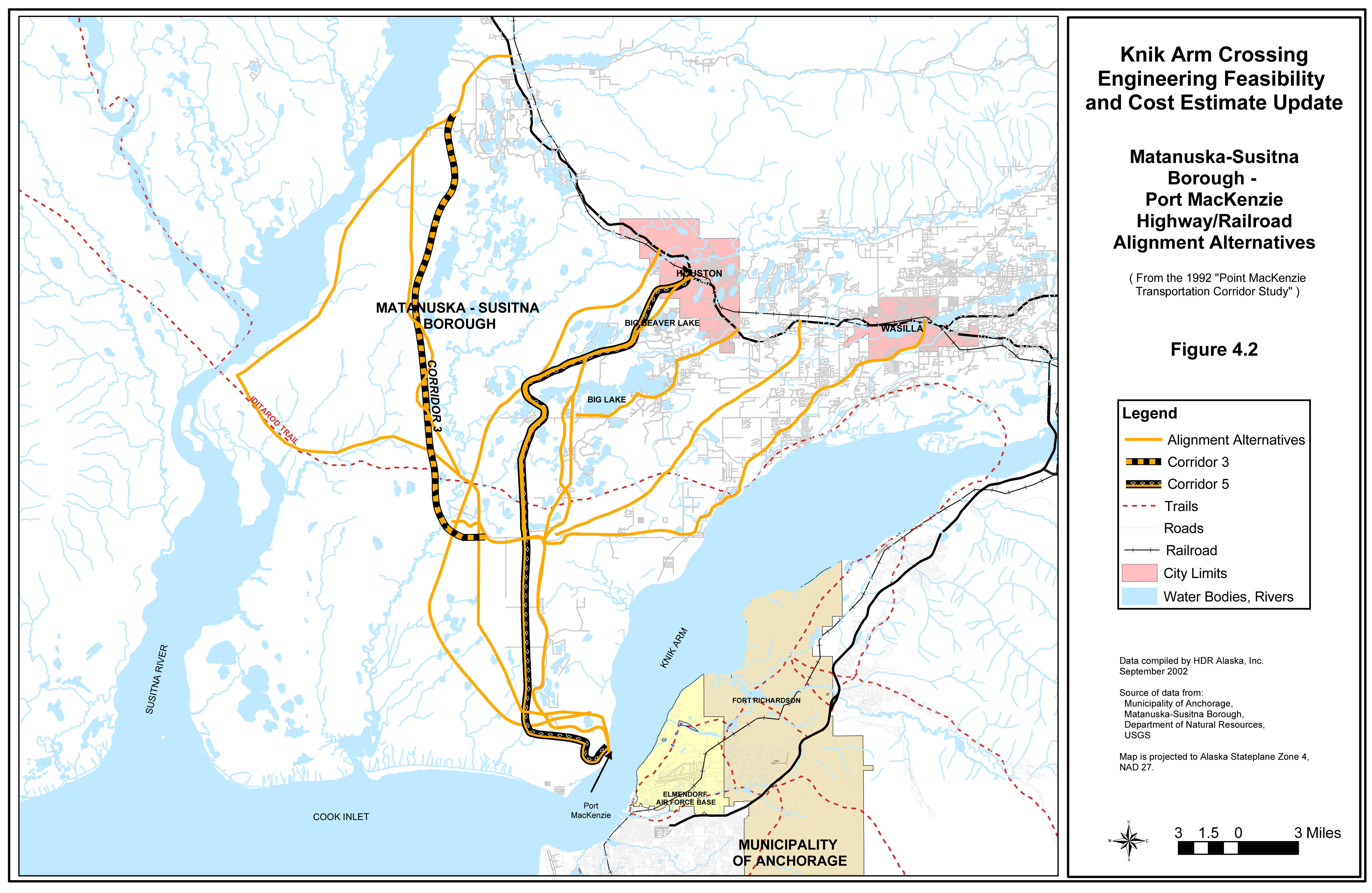
For both the conventional freight terminal and a possible HSR depot, access to Anchorage and onward transportation toward Houston and Alaska’s Interior should be planned together. A future Knik Arm bridge—or a tunnel if that alternative is selected—could shorten access from Anchorage to Point MacKenzie. Its wider value would depend partly on the roads and transport facilities reached on the western shore, including a suitable onward route toward the Parks Highway.
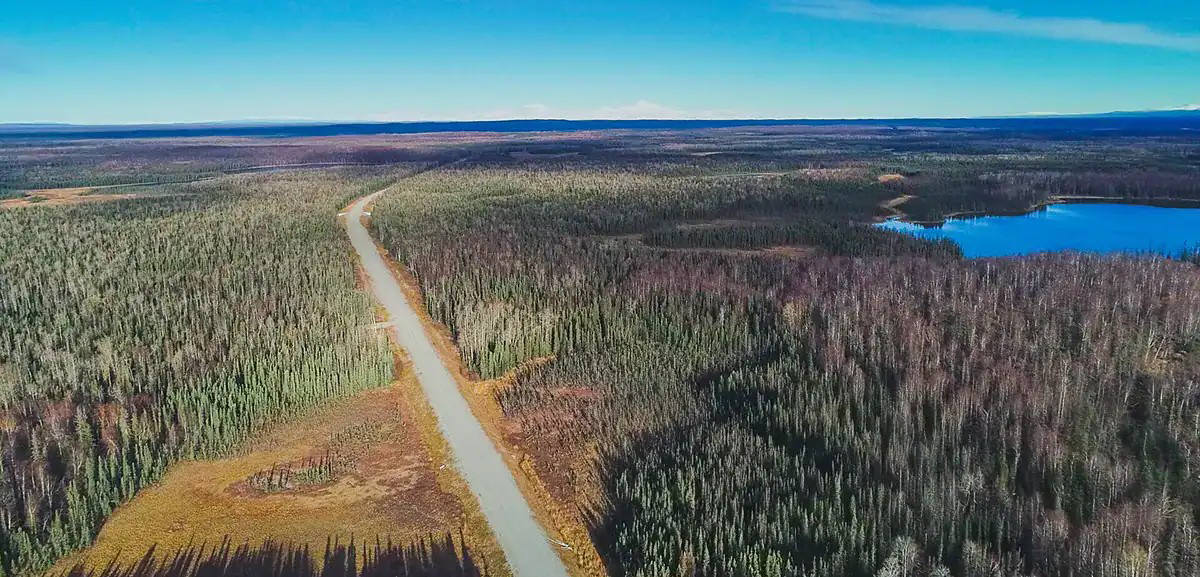
Point MacKenzie already has road access; the gap is the proposed direct, higher-capacity corridor toward Houston, rather than a complete absence of an inland connection. DOT&PF’s 2025 bridge-alternative study records that 9.6 miles of Point MacKenzie Road were upgraded and paved as a two-lane road in 2009. It also describes a proposed new industrial-route connection to the crossing and later highway capacity improvements. Existing access should therefore be distinguished from the larger through-route envisaged for future growth. [30]
Houston’s comprehensive plan provides the related northern planning context: the proposed Port-to-Parks highway would meet the Parks Highway bypass through a grade-separated interchange. As discussed earlier in this article, the highway layout and crossings must be coordinated with the Port MacKenzie rail connection near Houston. InterBering proposes treating the port railway, depot land, Knik Arm crossing approaches and onward highway as connected planning decisions, while recognizing that each requires its own approvals and funding. [18, 21]
The crossing history and a proposed construction sequence
The earlier Knik Arm toll-bridge project was paused in 2016, approximately ten years before this article, after extensive planning and financing work. DOT&PF attributes that pause to the state’s financial situation. Limited onward transport capacity is relevant to the development case, but the reviewed official record does not establish the absence of the port railway or a Houston highway as the reason the bridge was halted. [28]
Private participation had also been explored. A 2011 account of the procurement identified a Macquarie–Kiewit group among the teams shortlisted in an earlier process. That history indicates private-sector interest, not a completed financing agreement or a guarantee that the bridge would be built. [31]
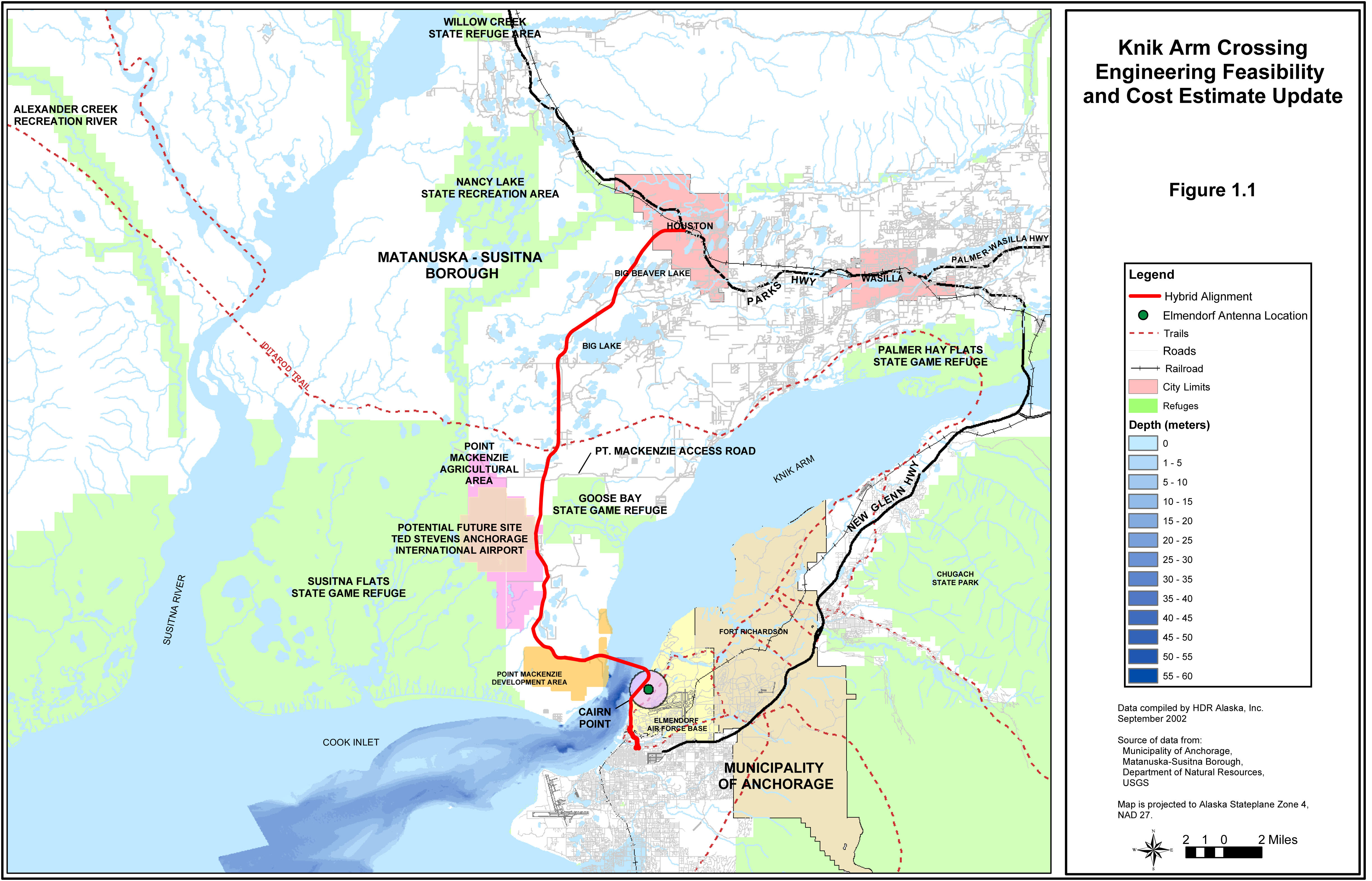
The crossing is again under examination. DOT&PF’s Connecting Southcentral Alaska program publishes a Knik Arm tunnel feasibility study and supporting documents, including a June 2025 update of bridge-alternative costs. This is renewed evaluation of alternatives, rather than confirmation that the earlier toll bridge will proceed. [29, 30]
InterBering’s proposed sequence is to complete the conventional rail connection and coordinate the onward highway corridor before, or alongside, major depot and crossing construction. Rail access could deliver heavy materials to the Point MacKenzie side of Knik Arm and reduce some construction-haul demands on local roads. Maritime delivery through the existing port would remain another option. Whether rail-first construction would reduce total cost or improve delivery would need to be tested in a project-specific logistics study; it is not an established condition imposed by state planners.
This staged approach would allow domestic freight infrastructure to support a prospective Alaska–Edmonton HSR depot and, later, a wider international corridor. A Bering Strait connection would still require extensive additional routes, agreements, environmental review and financing. The present port-extension award creates an opportunity to plan for those possibilities; it does not approve them.
Turning a funding milestone into lasting capacity
The next measure of success will be construction delivery and dependable service. A completed line must attract enough useful traffic to support its operating role and demonstrate the benefits anticipated by its sponsors. Cargo commitments, transparent costs and realistic schedules will matter as much as the announcement itself.
For longer-term Alaska–Canada planning, the project offers a concrete example of how an infrastructure proposal can advance through accumulated civil work, a defined public owner, state and local participation, and a federal completion award. It also shows why a larger corridor should be examined in useful stages, each with a clear purpose and an accountable delivery structure.
The $249 million award does not complete Alaska’s connection to North America. It can, however, strengthen an important part of the transportation system that a future connection would serve. For InterBering, that makes Port MacKenzie a development worth following closely: a near-term freight project with potential relevance to a much broader continental future.
Sources
-
[1] Tim Bradner, Mat-Su Sentinel, “Stalled Port MacKenzie rail project to get new life with $249 million federal grant,” republished by Anchorage Daily News, October 20, 2026. Additional reporting by Amy Bushatz.
-
[2] Alaska Business, “Feds Put $249M Toward Port MacKenzie Railroad Extension,” October 21, 2026.
https://www.akbizmag.com/industry/government/feds-put-249m-toward-port-mackenzie-railroad-extension/
-
[3] Alaska Railroad Corporation, “U.S. Transportation Secretary Sean P. Duffy Announces $249 Million Federal Grant Award to Complete Port MacKenzie Rail Extension,” October 19, 2026.
-
[4] U.S. Department of Transportation, “Trump’s Transportation Secretary Sean P. Duffy Delivers $250 Million Investment to Strengthen Alaskan Rail,” October 19, 2026.
-
[5] AIDEA, press release on the Port MacKenzie federal award and authorization of up to $34 million in matching funds, October 20, 2026.
-
[6] Alaska congressional delegation, “Alaska Delegation Announces $249 Million Federal Grant to Complete Port MacKenzie Rail Extension,” October 2026.
-
[7] The White House, “President Trump Visits Alaska: Delivering Results for the Last Frontier,” October 13, 2026.
-
[8] Factba.se / Roll Call, President’s Public Schedule, October 13, 2026, Wasilla rally entry.
-
[9] InterBering, international railway concepts and Alaska–Canada route discussion, accessed October 24, 2026.
-
[10] Fyodor Soloview, InterBering, “Bering Strait Tunnel Border and Customs Regime,” 2025.
-
[11] Fyodor Soloview, President, InterBering, LLC, letter to President Donald J. Trump, September 10, 2026, “Completing Alaska’s Railroad Connection to Canada and the Continental United States.” Text and immediate online acknowledgment supplied by Soloview; submission timing reported by the correspondent.
-
[12] The White House, “Response to your message,” email dated October 1, 2026, addressed to Mr. Soloview. PDF copy supplied by Soloview. The response contains general policy statements and no specific reference to rail funding. Read the October 1, 2026 White House response (PDF).
-
[13] Alaska Railroad Corporation, Leadership, official biography of Clark Hopp, Chief Operating Officer. Accessed October 24, 2026.
-
[14] Alaska Railroad Corporation, “Alaska Railroad announces new VP Engineering,” February 23, 2013.
https://www.alaskarailroad.com/sites/default/files/akrr_pdfs/2013_02_23_Rls_VPEngineering.pdf
-
[15] Alaska Railroad Corporation, “Railroad names new Chief Operating Officer,” December 8, 2017; appointment effective January 1, 2018.
-
[16] Alaska Railroad Corporation, Northern Rail Extension project fact sheet, dated April 24, 2013, hosted under a May 10, 2013 filename. Historical project scope and chronology.
-
[17] InterBering, “Connecting America and Russia By Railway Tunnel,” English translation of Maksym Drabok’s INTER television report broadcast September 23, 2012; identifies Clark Hopp as Director of Special Projects.
https://interbering.com/America-Russia-tunnel-connect.html
Clark Hopp photograph by Fyodor Soloview — source page: https://www.interbering.com/Clark-Hopp-Alaska-Railroad-Corp.html
-
[18] City of Houston Comprehensive Plan. Adopted September 8, 2016, City Council Ordinance 16-22; adopted February 21, 2017, Borough Assembly Ordinance 17-019. Prepared by R&M Consultants, Inc., Van Le, AICP, project manager. Transportation Plan recommendations: bypass and interchange. https://matsugov.us/docs/general/14624/2017-houston-comprehensive-plan.pdf
-
[19] InterBering. Houston rail extension and proposed highway bypass illustrative map. https://interbering.com/houston-rail-parks-hwy-bypass/imag000.jpg
-
[20] Fyodor Soloview. Photograph of the installed rail endpoint near Houston; location interpretation supplied by the photographer. https://interbering.com/houston-port-mackenzie-rail-end/imag000.jpg
-
[21] Matanuska-Susitna Borough, Ordinance Serial No. 17-019, adopting the Houston Comprehensive Plan, February 21, 2017. https://matsugov.us/docs/plans/14624/msb-2017-019-ordinance.pdf
-
[22] Amy Bushatz, Mat-Su Sentinel, “State orders new Knik Arm tunnel study,” November 14, 2024. Port MacKenzie photograph courtesy of the Matanuska-Susitna Borough. https://www.matsusentinel.com/state-orders-new-knik-arm-tunnel-study/
-
[23] InterBering, Port MacKenzie Rail Extension construction-status composite. Base map by Matanuska-Susitna Borough IT/GIS Division, August 19, 2025; Houston junction inset labeled as an illustrative reconstruction. https://interbering.com/port-mackenzie-extension-status/imag000.jpg
-
[24] Governor Mike Dunleavy, official Facebook post. Source of the photograph of the Port MacKenzie rail funding announcement. https://www.facebook.com/GovDunleavy/posts/pfbid0qgd5MPNkWUX1SXh8m9euTYRhjYpUauGhvMPiy66cACoPF1EMviu8iLszjKBuRADFl
-
[25] InterBering, “History and actual development,” interactive proposed high-speed railroad corridor map. https://interbering.com/History-and-actual-development.html
-
[26] Tim Bradner, Mat-Su Sentinel, “Stalled Port MacKenzie rail project to get new life with $249 million federal grant,” October 20, 2026. Additional reporting by Amy Bushatz. https://www.matsusentinel.com/stalled-port-mackenzie-rail-project-to-get-new-life-with-249-million-federal-grant/
-
[27] InterBering. “Port MacKenzie: Rail terminal loop and road access.” Annotated satellite map. Base imagery: Google Maps and the providers credited on the image. https://interbering.com/rail-terminal-loop-near-port/imag000.jpg
-
[28] Alaska DOT&PF. “Alaska DOT&PF Releases 2019 Knik Arm Crossing report on Financing & Construction,” April 29, 2022. https://dot.alaska.gov/comm/pressbox/arch2022/PR22-0020.shtml
-
[29] Alaska DOT&PF. Connecting Southcentral Alaska: Knik Arm Tunnel Feasibility Study and document library. https://dot.alaska.gov/creg/dev-csc/
-
[30] Stantec and Hemenway Consulting for Alaska DOT&PF. Knik Arm Tunnel Feasibility Study: Updated Bridge Alternative Cost Estimates, June 9, 2025, especially printed pages 16–18. https://dot.alaska.gov/creg/dev-csc/docs/KAC-Tunnel-Bridge-Cost-Estimate-Update.pdf
-
[31] Infrastructure Finance & Investment. “RFQ for Knik Arm Bridge Crossing in Alaska,” 2011. Historical account of procurement and shortlisted teams. https://www.infrapppworld.com/news/rfq-for-knik-arm-bridge-crossing-in-alaska
-
[32] Parsons Brinckerhoff/HDR Alaska, Inc. Knik Arm Crossing Engineering Feasibility and Cost Estimate Update, State Project No. 56047, Volume 1: Issues and Corridor Alignment. Prepared for Alaska Department of Transportation and Public Facilities, in affiliation with Lounsbury & Assoc., Inc., and Word Wrangling. January 31, 2003. Figure 4.2, Matanuska-Susitna Borough – Port MacKenzie Highway/Railroad Alignment Alternatives, based on the 1992 Point MacKenzie Transportation Corridor Study; map data compiled by HDR Alaska, Inc., September 2002. Map reproduction hosted by InterBering.
https://interbering.com/Port-Mackenzie-hwy-alternatives/imag000.jpg
-
[33] Parsons Brinckerhoff/HDR Alaska, Inc. Knik Arm Crossing Engineering Feasibility and Cost Estimate Update, State Project No. 56047, Volume 2: Technology Update. Prepared for Alaska Department of Transportation and Public Facilities, in affiliation with Fugro West, Inc.; ASCG, Inc.; Black-Smith & Richards; Shannon & Wilson, Inc.; TY Lin International; EKM Engineering, Inc. (subconsultant to TY Lin International); and Word Wrangling. January 31, 2003. Figure 1.1, Hybrid Alignment; map data compiled by HDR Alaska, Inc., September 2002. Map reproduction hosted by InterBering.
https://www.interbering.com/Knik-Arm-bridge-highway-Houston/imag000.jpg
-
[34] InterBering, LLC. “Anchorage–Edmonton High-Speed Rail Travel.” Home-page concept and illustrations. Illustrative distances and journey times are proposal assumptions, not an approved alignment or operating schedule. InterBering home page.